Sunday, May 17, 2020

Coronavirus Pandemic Summarized Timeline

There is a serious health crisis which must be duly resolved. But there is another important dimension which has to be addressed. 

Millions of people have lost their jobs, and their lifelong savings. In developing countries, poverty and despair prevail. 

While the lockdown is presented to public opinion as  the sole means to resolving a global public health crisis,  its devastating economic and social impacts are casually ignored.  

The entire World has been precipitated into a spiral of  mass unemployment, bankruptcy and extreme poverty.

Global Research, May 15, 2020

October 18, Event 201. New York. Coronavirus nCoV-2019 Simulation and Emergency Preparedness Task Force, John Hopkins Bloomberg School of Health Security.  Big Pharma-Big Money Simulation Exercise sponsored by WEF and Gates Foundation 

Simulation Exercise of a coronavirus epidemic which results in 65 million dead. Supported by the World Economic Forum (WEF) representing the interests of Financial institutions, the Bill and Melinda Gates Foundation representing Big Pharma.

January 1, 2020: Chinese health authorities close the Huanan Seafood Wholesale Market after Western media reports that wild animals sold there may have been the source of the virus. This initial assessment was subsequently refuted by Chinese scientists.

January 7, 2020: Chinese authorities “identify a new type of virus” which was isolated  on 7 January. The coronavirus was named 2019-nCoV by the WHO exactly the same name as that adopted in the WEF-Gates-John Hopkins October 18, 2019 simulation exercise. 

January 21-24, 2020: Consultations at the World Economic Forum, Davos, Switzerland under auspices of  the Coalition for Epidemic Preparedness Innovations (CEPI) for development of a vaccine program. CEPI is a WEF-Gates partnership. With support from CIPI, Seattle based Moderna will manufacture an mRNA vaccine against 2019-nCoV, “The Vaccine Research Center (VRC) of the National Institute of Allergy and Infectious Diseases (NIAID), part of NIH, collaborated with Moderna to design the vaccine.”

January  30, 2020: Geneva: WHO Director General determines that the outbreak constitutes a Public Health Emergency of International Concern (PHEIC). This decision was taken on the basis of 150 confirmed cases outside China, First case of person to person transmission in US is reported, 6 cases in the US, 3 cases in Canada, 2 in the UK.

The WHO Director General had the backing of the Bill and Melinda Gates Foundation, Big Pharma and the World Economic Forum (WEF). There are indications that the decision for the WHO to declare a Global Emergency was taken on the sidelines of the World Economic Forum (WEF) in Davos (January 21-24) overlapping with the Geneva January 22 meeting of the Emergency Committee.

Both WHO’s Director Tedros as well as Bill Gates were present at Davos 2020. Bill Gates announced the Gates Foundation’s $10 billion commitment to vaccines over the next 10 years.

January 30, 2020 The Simulation Exercise Went Live. The same corporate interests and foundations which were involved in the October 18 John Hopkins Simulation Exercise became REAL ACTORS involved in providing their support to the implementation of the WHO Public Health emergency (PHEIC).

January 31, 2020 – One day later following the launch of WHO Global Emergency, The Trump administration announced that it will deny entry to foreign nationals “who have traveled in China in the last 14 days”. This immediately triggers a crisis in air transportation, China-US trade as well as the tourism industry, leading to substantial bankruptcies, not to mention unemployment.

Immediately triggers a campaign against ethnic Chinese throughout the Western World.

Early February: the acronym of the coronavirus was changed from nCoV- 2019 (its name under the October Event 201 John Hopkins Simulation Exercise before it was identified in early January 2020) to COVID-19.

February 28, 2020: A massive WHO vaccination campaign was announced by WHO Director General Dr. Tedros Adhanom Ghebreyesus  

Late February 2020. Collapse of the stock markets, surge in the value of the stocks of Big Pharma.

Early March devastating consequences for the tourist industry Worldwide.

February 24:  Moderna Inc supported by CIPI  announced  that it experimental mRNA COVID-19 vaccine, known as mRNA-1273, was ready for human testing.

Late February 2020. Second wave of transmission of the virus (Worldwide) to a large number of countries.

Late February – Early March: China: More than 50% of the infected patients recover and are discharged from the hospitals. March 3, a total of 49,856 patients have recovered from COVID-19 and were discharged from hospitals in China.

March 7: USA: The number of “confirmed cases” (infected and recovered) in the United States in early March is of the order of 430, rising to about 6oo (March 8). Rapid rise in the course of March.

Compare that to the figures pertaining to the Influenza B Virus: The CDC estimates for 2019-2020 “at least 15 million virus flu illnesses… 140,000 hospitalizations and 8,200 deaths. (The Hill)

Early March:  IMF and World Bank To the Rescue 

The WHO Director General advises member countries that “the World Bank and the International Monetary Fund have both made funds available to stabilize health systems and mitigate the economic consequences of the epidemic”. That is the proposed neoliberal  “solution” to COVID-19. The World Bank has committed $12billion in so-called “aid” which will contribute to building up the external debt of developing countries.

March 7:  China: The Pandemic is Almost Over

Reported new cases in China fall to double digit. 99 cases recorded on March 7.  All of the new cases outside Hubei province are categorized as  “imported infections”(from foreign countries).

March 10-11, 2020: Italy declares a lockdown, followed by several other countries of the EU.  Deployment of 30,000 US troops in the EU as part of the “Defend Europe 2020” war games directed against Russia.

March 11, 2020: the Director General of the WHO officially declares the COV-19 Pandemic. Bear in mind the global health emergency was declared on January 3oth without stating officially the existence of a pandemic outside Mainland China.

March 11:  Trump orders the suspension for 30 days of all transatlantic flights from countries of the European Union, with the exception of Britain. Coincides with the collapse of airline stocks and a new wave of financial instability. Devastating impacts on the tourist industry in Western Europe.

March 16: Moderna  mRNA-1273 is tested in several stages with 45 volunteers in Seattle, Washington State. The vaccine program started in early February:

“We don’t know whether this vaccine will induce an immune response, or whether it will be safe. That’s why we’re doing a trial,” Jackson stressed. “It’s not at the stage where it would be possible or prudent to give it to the general population.” (AP, March 16, 2020)

March 21, 2020: Secretary of State Mike Pompeo while addressing the American people from the White House stated that COVID-19 is a live military exercise.

“This is not about retribution, … This matter is going forward — we are in a live exercise here to get this right.”

With a disgusted look on his face, President Trump replied: “You should have let us know.”

April 8, 2020: Mounting fear campaign led by Western media. Very rapid increase in so-called “confirmed cases”. “1,282,931 confirmed cases of COVID-19, including 72,776 deaths, reported to WHO” (April 8). Mounting doubts on the reported “confirmed cases” of COVID-19. Failures of the CDC’s categorization and statistical estimates.

March- April: Planet Lockdown. Devastating economic and social consequences. The economic and social impacts far exceed those attributed to the coronavirus. Cited below are selected examples of  a global process: 

  • Massive job losses and layoffs in the US, with more than 10 million workers filing claims for unemployment benefits.
  • In India,  a 21 days lockdown has triggered a wave of famine and despair affecting millions of homeless migrant workers all over the country. No lockdown for the homeless: “too poor to afford a meal”.  
  • The impoverishment in Latin America and sub-Saharan Africa is beyond description. For large sectors of the urban population, household income has literally been wiped out.
  • In Italy, the destabilization of the tourist industry has resulted in bankruptcies and rising unemployment. 
  • In many countries, citizens are the object of police violence. Five people involved in protests against the lockdown were killed by police in Kenya and South Africa.

Monday, April 27, 2020

The Islamic Roots of the Modern Hospital

Very few, both in the Muslim and Western worlds, are aware of the fact that it was the medieval Muslim physicians who took pioneering role in establishing well-designed and well-equipped hospitals that we find in modern time.


The Islamic Roots of the Modern Hospital
David W. Tschanz
Aramco, March-April issue, 2017

The hospital shall keep all patients, men and women, until they are completely recovered. All costs are to be borne by the hospital whether the people come from afar or near, whether they are residents or foreigners, strong or weak, low or high, rich or poor, employed or unemployed, blind or signed, physically or mentally ill, learned or illiterate. There are no conditions of consideration and payment; none is objected to or even indirectly hinted at for non-payment. The entire service is through the magnificence of God, the generous one. — policy statement of the bimaristan of al-Mansur Qalawun in Cairo, c. 1284CE

The modern West’s approach to health and medicine owes countless debts to the ancient past: Babylon, Egypt, Greece, Rome and India, to name a few. The hospital is an invention that was both medical and social, and today it is an institution we take for granted, hoping rarely to need it but grateful for it when we do. Almost anywhere in the world now, we expect a hospital to be a place where we can receive ease from pain and help for healing in times of illness or accidents.

We can do that because of the systematic approach — both scientifically and socially — to health care that developed in medieval Islamic societies. A long line of caliphs, sultans, scholars and medical practitioners took ancient knowledge and time-honored practices from diverse traditions and melded them with their original research to feed centuries of intellectual achievement and drive a continual quest for improvement. Their bimaristan, or asylum of the sick, was not only the true forerunner of the modern hospital, but also virtually indistinguishable from the modern multi-service healthcare and medical education center.

The bimaristan served variously as a center of treatment, a convalescent home for those recovering from illness or accident, a psychological asylum and a retirement home that gave basic maintenance to the aged and infirm who lacked a family to care for them.

Asylum of the Sick

The bimaristan was but one important result of the great deal of energy and thought medieval Islamic civilizations put into developing the medical arts. Attached to the larger hospitals— then as now — were medical schools and libraries where senior physicians taught students how to apply their growing knowledge directly with patients. Hospitals set examinations for the students and issued
diplomas. The institutional bimaristans were devoted to the promotion of health, the curing of diseases and the expansion and dissemination of medical knowledge.

The First Hospitals

Although places for ill persons have existed since antiquity, most were simple, without more than a rudimentary organization and care structure. Incremental improvements continued through the Hellenistic period, but these facilities would barely be recognizable as little more than holding locations for the sick. In early medieval Europe, the dominant philosophical belief held that the origin of illness was supernatural and thus uncontrollable by human intervention: As a result, hospitals were little more than hospices where patients were tended by monks who strove to assure the salvation of the soul without much effort to cure the body.

Muslim physicians took a completely different approach. Guided by sayings of the Prophet Muhammad (hadith) like “God never inflicts a disease unless He makes a cure for it,” collected by Bukhari, and “God has sent down the disease and the cure, and He has appointed a cure for every disease, so treat yourselves medically,” collected by Abu al-Darda, they took as their goal the restoration of health by rational, empirical means.

Hospital design reflected this difference in approach. In the West, beds and spaces for the sick were laid out so that the patients could view the daily sacrament of the Mass. Plainly (if at all) decorated, they were often dim and, owing to both climate and architecture, often damp as well. In the Islamic cities, which largely benefited from drier, warmer climates, hospitals were set up to encourage the movement of light and air. This supported treatment according to humoralism, a system of medicine concerned with corporal rather than spiritual balance.

Mobile Dispensaries

The first known Islamic care center was set up in a tent by Rufaydah al-Aslamiyah during the lifetime of the Prophet Muhammad. Famously, during the Ghazwah Khandaq (Battle of the Ditch), she treated the wounded in a separate tent erected for them.

Later rulers developed these forerunners of “mash” units into true traveling dispensaries, complete with medicines, food, drink, clothes, doctor and pharmacists. Their mission was to meet the needs of outlying communities that were far from the major cities and permanent medical facilities.

They also provided the rulers themselves with mobile care. By the early 12th-century reign of Seljuq Sultan Muhammad Saljuqi, the mobile hospital had become so extensive that it needed 40 camels to transport it. 


Permanent Hospitals

The first Muslim hospital was only a leprosarium—an asylum for lepers—constructed in the early eighth century in Damascus under Umayyad Caliph Walid ibn ‘Abd al-Malik. Physicians appointed to it were compensated with large properties and munificent salaries. Patients were confined (leprosy was well known to be contagious), but like the blind, they were granted stipends that helped care for their families.

The earliest documented general hospital was built in 805 in Baghdad.

The earliest documented general hospital was built about a century later, in 805, in Baghdad, by the vizier to the caliph Harun al-Rashid. Few details are known, but the prominence as court physicians of members of the Bakhtishu’ family, former heads of the Persian medical academy at Jundishapur, suggests they played important roles in its development.

Over the following decades, 34 more hospitals sprang up throughout the Islamic world, and the number continued to grow each year. In Kairouan, in present-day Tunisia, a hospital was built in the ninth century, and others were established at Makkah and Madinah. Persia had several: One in the city of Rayy was headed for a time by its Baghdad-educated native son, Muhammad ibn Zakariya al-Razi.

In the 10th century five more hospitals were built in Baghdad. The earliest was established in the late ninth century by ‘Al-Mu’tadid, who asked Al-Razi to oversee its construction and operations. To start, Al-Razi wanted to determine the most salubrious place in the city: He had pieces of fresh meat placed in various neighborhoods, and some time later, he checked to determine which had rotted the least and sited the hospital there. When it opened, it had 25 doctors, including oculists, surgeons and bonesetters. The numbers and specialties grew until 1258, when the Mongols destroyed Baghdad.

The vizier ‘Ali ibn Isa ibn Jarah ibn Thabit wrote in the early 10th century to the chief medical officer of Baghdad about another group: "I am very much worried about the prisoners. Their large numbers and the condition of prisons make it certain that there must be many ailing persons among them. Therefore, I am of the opinion that they must have their own doctors who should examine them every day and give them, where necessary, medicines and decoctions. Such doctors should visit all prisons and treat the sick prisoners there."


Shortly afterward a separate hospital was built for convicts, fully staffed and supplied.

In Egypt, the first hospital was built in 872 in the southwestern quarter of Fustat, now part of Old Cairo, by the ‘Abbasid governor of Egypt, Ahmad ibn Tulun. It is the first documented facility that provided care also for mental as well as general illnesses. In the 12th century, Saladin founded in Cairo the Nasiri hospital, which later was surpassed in size and importance by the Mansuri, completed in 1284. It remained the primary medical center in Cairo through the 15th century, and today, renamed Qalawun Hospital, it is used for ophthalmology.

In Damascus the Nuri hospital was the leading one from the time of its foundation in the mid-12th century well into the 15th century, by which time the city contained five additional hospitals.

In the Iberian Peninsula, Cordóba alone had 50 major hospitals. Some were exclusively for the military, and the doctors there supplemented the specialists who attended to the caliphs, military commanders and nobles.

Organization

In a fashion that would still be recognizable today, the typical Islamic hospital was subdivided into departments such as systemic diseases, surgery, ophthalmology, orthopedics and mental diseases. The department of systemic diseases was roughly equivalent to today’s department of internal medicine, and it was usually further subdivided into sections dealing with fevers, digestive troubles, infections and more. Larger hospitals had more departments and diverse subspecialties, and every department had an officer-in-charge and a presiding officer in addition to a supervising specialist.

Hospitals were staffed also with a sanitary inspector who was responsible for assuring cleanliness and hygienic practices. In addition, there were accountants and other administrative staff to assure that hospital conditions — financial and otherwise — met standards. There was a superintendent, called a sa’ur, who was responsible for overseeing the management of the entire institution.

Physicians worked fixed hours, during which they saw the patients who came to their departments. Every hospital had its own staff of licensed pharmacists (saydalani) and nurses. Medical staff salaries were fixed by law, and compensation was distributed at a rate generous enough to attract the talented.

Funding for the Islamic hospitals came from the revenues of pious bequests called waqfs. Wealthy men and rulers donated property to existing or newly built bimaristans as endowments, and the revenues from the bequests paid for building and maintenance. To help make it pay, such revenues could come from any mix on the property of shops, mills, caravanserais or even entire villages. The income from an endowment would sometimes also cover a small stipend to the patient upon dismissal. Part of the state budget also went toward the maintenance of hospitals. To patients, the services of the hospital were free, though individual physicians occasionally charged fees.

Patient Care

Bimaristans were open to everyone on a 24-hour basis. Some only saw men while others, staffed by women physicians, saw only women; still others cared for both in separate wings with duplicate facilities and resources. To treat less serious cases, physicians staffed outpatient clinics and prescribed medicines to be taken at home.

Special measures were taken to prevent infection. Inpatients were issued hospital wear from a central supply area while their own clothes were kept in the hospital store. When taken to the hospital ward, patients would find beds with clean sheets and special stuffed mattresses ready. The hospital rooms and wards were neat and tidy with abundant running water and sunlight.

Inspectors evaluated the cleanliness of the hospital and the rooms on a daily basis. It was not unusual for local rulers to make personal visits to make sure patients were getting the best care.

The course of treatment prescribed by doctors began immediately upon arrival. Patients were placed on a fixed diet, depending on condition and disease. The food was of high quality and included chicken and other poultry, beef and lamb, and fresh fruits and vegetables.

The major criterion of recovery was that patients be able to ingest, at one time, an amount of bread normal to a healthy person, along with the roasted meat of a whole bird. If patients could easily digest it, they were considered recovered and subsequently released. Patients who were cured but too weak to discharge were transferred to the convalescent ward until they were strong enough to leave. Needy patients were given new clothes, along with a small sum to aid them in re-establishing their livelihood.


Below is the translation of a young Frenchman’s letter from a Cordóba hospital in the 10th century:
You have mentioned in your previous letter that you would send me some money to make use of it in my medicines costs. I say, I don’t need it at all as treatment in this Islamic hospital is for free. Also there is something else concerning this hospital. This hospital gives a new suit and five dinars to every patient who has already got well lest he should find himself obliged to work in the period of rest and recuperation.

Dear father, if you’d like to visit me, you will find me in the surgery department and joints treatment. When you enter the main gate, go to the south hall where you will find the department of first aid and the department of disease diagnosis then you will find the department of arthritis (joint diseases). Next to my room, you will find a library and a hall where doctors meet together to listen to the lectures given by professors; also this hall is used for reading. The gynecology department lies on the other side of the hospital court. Men are not allowed to enter it. On the right of the hospital court lies a large hall for those who recovered. In this place they spend the period of rest and convalescence for some days. This hall contains a special library and some musical instruments.

Dear father, any place in this hospital is extremely clean; beds and pillows are covered with fine Damascus white cloth. As to bedcovers, they are made of gentle soft plush. All the rooms in this hospital are supplied with clean water. This water is carried to the rooms through pipes that are connected to a wide water fountain; not only that, but also every room is equipped with a heating stove. As to food, chicken and vegetables are always served to the extent that some patients do not want to leave the hospital because of their love and desire of this tasty food. — The Islamic Scientific Supremacy. Ameer Gafar Al-Arshdy. 1990, Beirut, Al-Resala Establishment.


The 13th-century doctor and traveler ‘Abd al-Latif al-Baghdadi, who also taught at Damascus, narrated an amusing story of a clever Persian youth who was so tempted by the excellent food and service of the Nuri hospital that he feigned illness. The doctor who examined him figured out what the young man was up to and admitted him nevertheless, providing the youth with fine food for three days. On the fourth day, the doctor went to his patient and said with a rueful smile, “Traditional Arab hospitality lasts for three days: Please go home now!”

The quality of care was subject to review and even arbitration, as related by Ibn al-Okhowa in his book ‘Ma’alem al-Qurba fi Talab al-Hisba’ (The Features of Relations in al-Hisba):

If the patient is cured, the physician is paid. If the patient dies, his parents go to the chief doctor; they present the prescriptions written by the physician. If the chief doctor judges that the physician has performed his job perfectly without negligence, he tells the parents that death was natural; if he judges otherwise, he tells them: Take the blood money of your relative from the physician; he killed him by his bad performance and negligence. In this honorable way, they were sure that medicine is practiced by experienced, well-trained persons.

In addition to the permanent hospitals, cities and major towns also had first aid and acute care centers. These were typically located at busy public places such as large mosques. Maqrizi described one in Cairo:

Ibn Tulun, when he built his world-famous mosque in Egypt, at one end of it there was a place for ablutions and a dispensary also as annexes. The dispensary was well equipped with medicines and attendants. On Fridays there used to be a doctor on duty there so that he might attend immediately to any casualties on the occasion of this mammoth gathering.

Medical Schools & Libraries

Because one of the major roles of the hospitals was the training of physicians, each hospital had a large lecture theater where students, along with senior physicians and medical officers, would meet and discuss medical problems in seminar style. As training progressed, medical students would accompany senior physicians to the wards and participate in patient care — much like a modern residency program.

Surviving texts, such as those in Ibn Abi Usaybi’ah’s ‘Uyun al-anba’ fi tabaqat al-atibb’ (Sources of Information on Classes of Physicians), as well as student notes, reveal details of these early clinical rounds. There are instructions on diets and recipes for common treatments, including skin diseases, tumors and fevers. During rounds, students were told to examine the patients’ actions, excreta, and the nature and location of swelling and pain. Students were also instructed to note the color and feel of the skin, whether hot, cool, moist, dry or loose.

Training culminated in an examination for a license to practice medicine. Candidates had to appear before the region’s government-appointed chief medical officer. The first step required was to write a treatise on the subject in which the candidate wanted to obtain a certificate. The treatise could be an original piece of research or a commentary on existing texts, such as those of Hippocrates, Galen and, after the 11th century, Ibn Sina, and more.

Candidates were encouraged not only to study these earlier works, but also to scrutinize them for possible errors. This emphasis on empiricism and observation rather than slavish adherence to authorities was one of the key engines of the medieval Islamic intellectual ferment. Upon completion of the treatise, candidates were interviewed at length by the chief medical officer, who asked them questions relevant to problems of the prospective specialties. Satisfactory answers led to licensed practices.

Another key aspect to the hospital, and of critical importance to both students and teachers, was the presence of extensive medical libraries. By the 14th century, Egypt’s Ibn Tulun Hospital had a library comprising 100,000 books on various branches of medical science. This was at a time when Europe’s largest library, at the University of Paris, held 400 volumes.

Cradle of Islamic medicine and prototype for today’s hospitals, bimaristans count among numerous scientific and intellectual achievements of the medieval Islamic world. But of them all, when ill health or injury strikes, there is no legacy more meaningful.

Coffee Renaissance in the Middle East...

Gahwa, the Arabic word for coffee, is a ceremonial affair in which each cup is infused with history and social significance.

Gahwa Renaissance
Shaistha Khan
Illustrated by Teresa Abboud
Aramco, March/April 2020


Coffee Origins

The discovery of coffee is popularly attributed to Kaldi, a goat herder who lived in Ethiopia in the fifth century CE. As the story goes, he noticed that his goats became unusually energetic after chewing on the coffee cherry. Soon after his discovery, monks took to chewing coffee beans to stay awake during night prayers. Beginning in the seventh century, Muslim pilgrims brought coffee beans
across the Red Sea, where the western highlands of the Arabian Peninsula proved fertile for the new crop. There, coffee beans began to be roasted and brewed. By the 16th century, gahwa was a major export, especially from the Yemeni port of Mocha, to Ottoman Turkey and, from there, to the world.

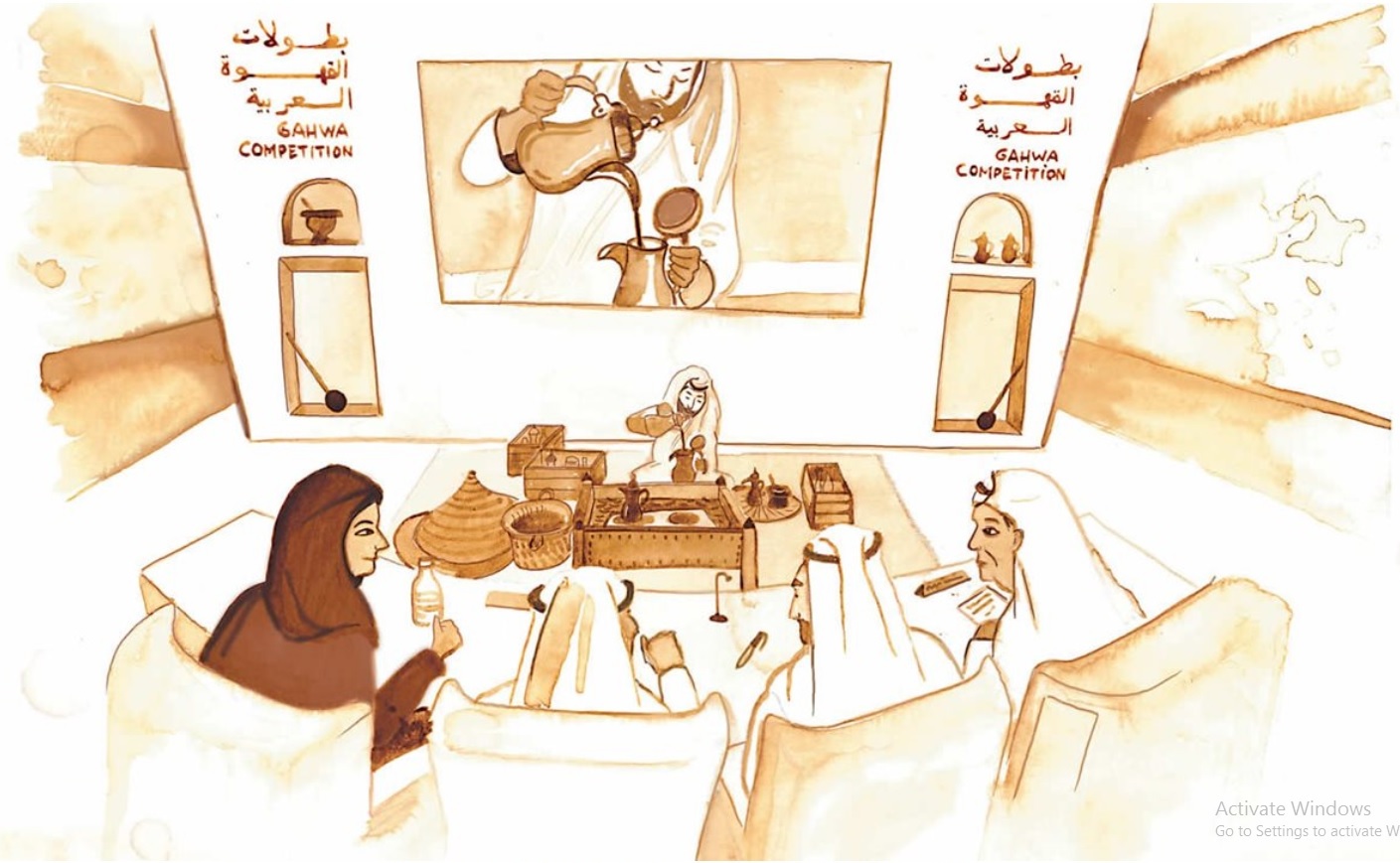
As Zayed al-Tamimi’s brass pestle hits the mortar, its rhythmic clink resounds with the crunch of coffee beans through the hall of the Abu Dhabi National Exhibition Centre. On a display screen above him, closeups of his motions attract the eyes of coffee professionals and enthusiasts. Watching most closely is the panel of four judges.

Al-Tamimi has traveled from Iraq to the capital of the United Arab Emirates (uae) to compete in the first-ever Gahwa Championships, held in December.  He is preparing a signature pot of gahwa — the Arabic word for coffee — as he vies for honors in the category of Sane’

Al Gahwa, (literally, “Maker of the Coffee”). As he drops thick pods of cardamom and delicate threads of saffron into the mortar to crush with the beans, he fuses all he has learned about centuries-old Arab coffee-making. A later competition includes Dubai barista Louie Alaba, who offers the judges his cold-brew “gahwaccino” that uses fig, chili and cinnamon. As the competitions hit a stride, attendees discuss the importance of coffee-making across the whole of the Arab world, and how it is not just a matter of a dark- or light-roast beverage served with optional sugar and milk. Arab gahwa is a ceremonial affair, each pour symbolic of the historical and social significance of coffee drinking and an embodiment of hospitality. Coffee is synonymous with Arab hospitality.


In the uae, 1-dirham coins pay homage to coffee culture by showing gahwa’s most time-honored symbol, the dalah, or the traditional Arab coffee pot, with its  wide, stable bottom, elongated handle, finial lid and gracefully thin, beak-like spout. Across the Arabian Peninsula, it is not unusual to see a giant-sized dalah erected as public art in the middle of a traffic roundabout.

In his 1982 poem “Memory for Forgetfulness,” the late, celebrated Palestinian poet Mahmoud Darwish described the first cup of morning coffee as the “mirror of the hand.” He continued: “And the hand that makes the coffee reveals the person that stirs it. Therefore, coffee is the public reading of the open book of the soul. And it is the enchantress that reveals whatever secrets the day will bring.”

So important is gahwa in the Arab world the United Nations Educational, Scientific and Cultural Organization (unesco) included gahwa in the UAE, Saudi Arabia, Oman and Qatar in the agency’s 2015 Representative List of the Intangible Cultural Heritage of Humanity.

The designation recognized the value of preserving the historical customs and traditions of coffee drinking in these nations. Eid Bin Saleh Al Rashid of Saudi Arabia’s Royal Hospitality House Group, and one of the supporters for the unesco designation, emphasized coffee’s importance for the future of culture in his country, “given its symbolic meaning for national identity and in order to preserve and pass this element to younger generations.”


In the desert at the eastern edge of the vast Rub’ al-Khali, heritage guides Waesam Fathalla and Ali al-Baloushy are doing just that.

They share centuries-old coffee traditions with tourists, in much the same way their tribes shared with visitors centuries ago: out under the stars, sheltered by a tent, sitting with friends on floor cushions.

Like all good gahwa, they begin with green, unroasted Arabica or robusta beans. Over a makeshift pit of hot coals and sand, Fathalla roasts the beans in a shallow, circular pan with a handle long enough to keep his hands safely away from the fire. The beans bounce back and forth revealing a golden-brown shade and a faint floral aroma. Fathalla explains that while Saudi tradition favors light, blonde roasts, Emirati purists favor darker roasts. Once the beans are ready, they’re removed from the fire and ground into powder using a mortar and pestle. Water boils in a dalah, and nutmeg, clove or cinnamon is added before the coffee.

“Emiratis don’t use too many spices in their gahwa. That way, the natural flavor of the coffee can really come through,” Fathalla says as he grinds the coffee beans.

Throughout the centuries, coffee has been a unifying drink, something to do with family and friends old and new. The spices and flavoring in it can signal one’s economic status, level of respect for a guest, or both. Coffee recipes with saffron and rose water demonstrated wealth and regard for a guest most clearly.

He adds the coffee powder to boiling water and leaves it to bubble for a few minutes. Then he removes the dalah from the heat and allows it to rest, so the coffee grinds settle at the bottom. He then pours from it into another dalah with a filter, and then again into a smaller, ornate serving dalah.

Al-Baloushy begins to explain the role of the gahwaji or server of the coffee, as his assistant begins pouring. The gahwaji holds the dalah in his left hand and balances in his right hand a stack of finajin (handless cups; one cup is a finjan). He gently clinks the cups together to signal the coffee is ready.

Although there are regional preferences and variations in both the preparation and serving of gahwa, the basics of the ceremony remain much the same from place to place.


Al-Baloushy tries the first cup to determine if the coffee is suitably tasty. Then he begins serving the first of three rounds. The first guest cup is al-dhaif, and it cannot be refused without risking insult to the hosts. The coffee is a gift, the men explain, and it establishes trust. To each guest as the gahwaji hands out the cups, al-Baloushy says, “You are welcome.”

The heart of the ceremony, he says, is hospitality, a cherished Bedouin value. As nomads, Bedouins often lived in harsh conditions with scarce resources. They relied on reciprocal generosity among the communities and tribes they encountered. Still today, any traveler or visitor, as was the custom of their older tribesmen, is always hosted, sheltered and fed for three days and three nights with no questions asked. All visitors receive a welcoming cup of coffee; simply placing a dalah atop a fire pit is invitation enough for anyone to join.

The second cup he serves is al-kaif, for enjoyment and pleasure. Finally, al-saif—literally the cup of the sword—is served, traditionally when the parties have established a protection deal between them—a promise to defend one another in the event of threats against their people.

It is also significant that the gahwaji first serves the most important person in the majlis, or social seated assembly. Usually, al-Baloushy says, this is the eldest person or a guest of honor. Then he serves the remaining guests, beginning with those on the right of the guest of honor.

“There are many hidden messages in the way we prepare

and serve coffee,” al-Baloushy explains.

As guests sip, they can politely communicate a message without offending or embarrassing others in the group. For example, he says that filling a guest’s cup two-thirds full means you are welcome to stay. If, however, if it is served full to the brim, this indicates the guest may not be so welcome.

“So you drink and leave,” he says.

Placing his own finjan on the ground, al-Baloushy demonstrates that this gesture communicates the guest has an important matter to discuss or a request to make of the host.

“If the time is right, I will talk to him and give him my full attention. If he is satisfied with my reply, he  will drink the coffee. If not, he will leave the majlis,” al-Baloushy says.

The gahwaji remains standing to keep an attentive watch on everyone’s cup. Shaking the finjan sideways is the acceptable way of declining another cup.

Abdullah Khalfan al-Yammahi, a heritage expert and author of Etiquette of Gahwa Serving in the uae, explains how coffee brings together people of different ages, social classes and tribes.

“We sit together to discuss and debate. We talk about anything and everything,” says al-Yammahi, who is one of the four judges at the Gahwa Championships. “A dalah is seen as a living entity because it is present in our happy occasions and in sad ones.”

As al-Tamimi replicates the coffee ceremony during the Sane’ Al Gahwa competition, the judges also quiz him on etiquette.

“There are more than 44 adab [etiquette rules] of serving gahwa and more than 22 rules of receiving gahwa,” al-Yammahi explains. This is why it is important that younger generations learn how to interact with others through exposure to the majlis and its rituals.

“Something as simple as bending forward to serve is an act of respect and demonstrates morals,” he says.
To encourage dialog, raise awareness and safeguard the coffee ceremony as cultural heritage, Abu Dhabi’s Department of Culture and Tourism has sponsored several programs, of which the Gahwa Championships are one. Another is the Bait Al Gahwa (House of Coffee) initiative that, since 2018, has encouraged young Emiratis to train with heritage experts and operate tourism projects related to the ceremony.

Khalid Al Mulla is owner of the Dubai Coffee Museum, national coordinator for the country’s chapter of the Specialty Coffee Association, and a promoter of regional and international coffee-culture preservation.

“The coffee business is all about education, whether that is bringing gahwa to the forefront of the global coffee industry and making it a mainstream beverage, or preserving culture by serving gahwa at formal events, or educating local customers on fair trade and ethically sourced coffee,” he says.

Al Mulla’s small, private museum in Dubai’s heritage-oriented al-Bastakiya district is one way young people and visitors can glimpse the spectrum of Arab coffee, from its origins to its ceremonies, artifacts, tools and early modern technology.

Mohamed Ali Madfai owns the cafe Emirati Coffee Co, and he observes that everywhere “the coffee bean is the same, yet the culture of brewing and serving is different.” He likens the Arab dalah to the Turkish ibrik, with its iconically wide bottom and slanted handle.


“Just like Vietnamese-style coffee gained popularity in [the Arabian Peninsula] as much as a Spanish latte, with education and promotion, gahwa could become a mainstream drink in cafes around the world,” he says, noting cafes offering traditional Arab coffee report high demand. Modernizing “gahwa culture,” he adds, will not strip away tradition because “tradition lasts longer than gimmick.”

Zainab Al Mousawi, 31, serves cold-brewed traditional Arab coffee in her Dubai cafe, To the Moon & Back. “I find gahwa incomparable to specialty coffee. As it is brewed with spices, it makes for a special drink,” she says. “Gahwa and specialty drinks each have their own audience, how and when to be served, and consumed.”


Her gahwa uses single-origin beans and a spice mix, and she brews it over ice using a slow-drip method, another way young coffee innovators are fusing past and present as well as regional and international influences.


“Although young people may be influenced by foreign culture or trends, they always come back to their roots,” says heritage expert and author al-Yammahi. “They recognize their heritage and traditions. It makes me proud to see their involvement and investment in this intangible heritage.”

Tuesday, April 7, 2020

Identifying Einstein...

For Albert Einstein, being Jewish and German were not questions of identity but rather mutable matters of identification...

Identifying Einstein
Michael D Gordin
Aeon, April 2, 2020
Germanness and Jewishness have each been impossible for centuries of European history. In a time when political legitimacy meant a nation-state, the Germans were long too big to be contained within a single one, and the Jews long too despised and dispersed to have their own. In the mid-20th century, the murderous atrocities of National Socialism would lock Germanness and Jewishness in seemingly mortal opposition. But before the rise of Nazism and its historic crimes, no inherent conflict stood between Germanness and Jewishness. Ostensibly, bloodline or heritage determined both of these, but in actuality each was an amalgam of confession, language and class, any of which could change over the course of a life.

For centuries in central Europe, being labelled both German and Jewish was commonplace. Often, what individuals meant when identifying themselves as one could reshape how they were understood to relate to the other. Declaring yourself to be German as well as Jewish acquired different valences when your audience primarily understood itself (and you) as one or the other. Identification is part individual volition and part a process of being identified – by states, religious groups and other institutions and communities. An individual’s biography is but one important variable in the equation. Let’s take one example you will certainly recognise.

As quotable as he was photogenic, Albert Einstein can lull us into thinking he was made for the Twitter and Instagram click-a-thon, though it was tabloid vignettes and newsreels that helped to power his rise to global celebrity. Einstein has been massively famous for just over a century, catapulting to worldwide renown in the wake of the 1919 eclipse expedition led by the British astronomers Arthur Stanley Eddington and Frank Watson Dyson to measure how much starlight would bend around the massive body of our Sun while it was conveniently shrouded in an eclipse. Eddington and Dyson declared Einstein’s predictions correct. The newspapers ran with it, and the moustachioed theoretical physicist captivated the public.

It was all a bit inexplicable then, and remains a matter of discussion among historians today. In late November 1919, Einstein had his own take, in The Times in London:

    Today I am described in Germany as a ‘German savant’, and in England as a ‘Swiss Jew’. Should it ever be my fate to be represented as a bête noire, I should, on the contrary, become a ‘Swiss Jew’ for the Germans and a ‘German savant’ for the English.

As with much of Einstein’s humour, there is a barb within the bonbon. He understood that the names commonly used to describe one’s ‘identity’ are not entirely under one’s control.

The crux of the issue is the term ‘identity’ itself. It can be tempting to think that identities are immutable and self-evident. Because neither is quite true, the sociologist Rogers Brubaker and the historian Frederick Cooper would prefer we dispensed with the term ‘identity’ altogether in favour of ‘identification’. As they noted in 2000, the longer and somewhat more clinical term

    invites us to specify the agents that do the identifying. And it does not presuppose that such identifying (even by powerful agents, such as the state) will necessarily result in the internal sameness, the distinctiveness, the bounded groupness that political entrepreneurs may seek to achieve.

Sometimes, you are the one doing the identifying (of self or other); sometimes, you are being identified. The magic comes in tricking you into thinking that those identifications are your intrinsic identity. Appreciating that power shapes how we think of ourselves and others opens up new perspectives on xenophobic nationalism and antisemitism, and new possibilities for thinking about ourselves and others.

Einstein’s changing identifications illustrate the role of power in identification and the mutability of claims to identity. Throughout his life, he was repeatedly referred to as a ‘German’ and a ‘Jew’, two terms that we have come to interpret, since the mid-20th century, as being at odds. Yet Einstein identified as both, albeit with reservations. He resisted attempts by others (especially state bureaucrats) to prescribe identifications to him, while also mobilising assertions of identification to support pacifism, Zionism and other commitments. It is quite rare for identifications to exist in the singular or to remain fixed over time, and so it proved in Einstein’s case.

The first record we have of Einstein’s views on being German involve him denying it. He was born in 1879 in Ulm, in the German state of Württemberg, and he retained that citizenship upon the family’s departure, shortly afterward, to Munich, the capital of the state of Bavaria. As he approached graduation from secondary school, Einstein refused to enlist in the obligatory military service. A month and a half shy of his 17th birthday (and thus still a minor) he asked his father to renounce his citizenship for him. As of 5 February 1896, when Ulm confirmed the decision, Einstein was officially stateless.

He soon settled in Switzerland and eventually enrolled at the Swiss Federal Polytechnic School, later renamed the Federal Institute of Technology (ETH), in Zürich. He became a Swiss citizen on 21 February 1901, five years after he had forsaken his German citizenship. Born within the newly formed German Reich, Einstein was happier being Swiss.

He kept his passports in order, but didn’t put much stock in nations. In a manuscript drafted between late October and early November 1915, and eventually sent to a pacifist organisation for publication, he wrote:

    The state to which I belong as a citizen plays scarcely any role in my emotional life; I consider the affiliation with a state as a business arrangement, something like the relationship to a life insurance policy.

So he wrote – and then crossed it out, perhaps because it was rather too strong a statement to be published while Germany was in the grips of the Great War.

Indeed, it was to Einstein’s advantage to keep quiet about citizenship questions. Although he was now a professor at the University of Berlin and a director of the Kaiser Wilhelm Institute for Physics, and thus a German civil servant, his insistence that he was a Swiss citizen meant that he was not approached for war work. He confirmed this status in a letter to the Berlin-Schöneberg Office of Taxation in 1920: ‘I am Swiss, here in Berlin since early 1914.’

Einstein’s Nobel Prize in Physics proved an inconvenience for his non-German Swissness

Einstein’s cavalier attitude to his Germanness put him at odds with some of his closest friends. Unique among scientist colleagues in the Central Powers, he was not subjected to the boycott and travel ban that the victorious powers of France, Belgium, Britain and the United States imposed after the war. The news of the confirmation of general relativity afforded an excellent occasion to invite Einstein, a well-known pacifist and opponent of the war, to Paris or New York where he might quietly lobby to end the boycott, which he opposed as a manifestation of virulent nationalism. The chemist Fritz Haber and other friends objected to Einstein’s globetrotting as disloyal to the sufferings of Germans. Einstein’s response dismissed the matter of national loyalty: ‘Allegiance to the political image of Germany would be unnatural for me as a pacifist.’ He went on the trip to the US, and then on another to Japan, China and the British Mandate of Palestine, all on his Swiss passport.

In 1922, Einstein declared to Gilbert Murray, the Australian-born British man of letters, that:

    I am not an appropriate representative for German intellectuals, because I am not seen by them in their full number as their representative. My outspoken international attitude, Swiss citizenship and Jewish nationality work together so that I would not be met in a political relationship by the majority of the masses with the trust that a representative of a country must possess to be able to serve as a link with success.

Einstein sketched out an array of identifications here, noting that they worked to make his own Germanness impossible.

In 1922, while in Japan, Einstein was awarded the Nobel Prize in Physics for the previous year, an event that proved an inconvenience for his non-German Swissness. Nobel Prizes needed to be received in person; if the laureate were not personally able, an ambassador would stand in. Naturally, the Swiss ambassador presented himself for the honour, given that Einstein was at that very moment travelling as a citizen of the canton of Zurich. So did Rudolf Nadolny, the German ambassador to Sweden. The Germans maintained that German citizenship attached to Einstein as a requirement of his Berlin post. Einstein had objected to this clause during negotiations in December 1913, and the Germans had not felt it necessary to contest the point later during the war. With the Nobel Prize, circumstances had changed, and Nadolny accepted the award on his behalf. Einstein at first protested his symbolic de-Swissification, but within a year relinquished his opposition to the state’s narrative, and settled in as a German citizen.

Everything changed on 25 August 1933, when Germany’s National Socialist government rescinded Einstein’s citizenship. He at once became the world’s most famous refugee. He was granted asylum in the US and a position at the Institute for Advanced Study in Princeton, where he became a prominent advocate for those displaced by Hitler’s racial laws and the war. In 1935, the Einstein family travelled to Bermuda so that they could re-enter the US on permanent visas. On 1 October 1940, after the obligatory five-year waiting period, Einstein, his stepdaughter and his secretary all took their oath of allegiance as US citizens. Even now – he was perhaps the most recognisable American alive – Einstein’s vocal support for civil rights and nuclear disarmament provoked J Edgar Hoover’s FBI to explore the possibility of stripping Einstein of his citizenship as an undesirable immigrant. The FBI’s quixotic effort against the massively popular Einstein failed, and the physicist died as a US citizen. The question of whether he had ever been ‘German’ remains a matter of dispute.

Einstein’s Germanness might seem to be a matter of a passport or other formal registration, an identification that was externally granted or taken away. One might assume, as a matter of course, that Jewishness is something different, not just externally ascribed but also internally embraced – a matter for identity, not just identification. For Einstein, the interaction between active and passive identification for confession and ethnicity was even more turbulent than nationality.

His reluctance to affiliate with organised religion began in childhood. His parents identified as Jews and, though not devout, adhered to some of the outward customs. As a boy, he became curious about going deeper into the rites, at least for a time. In 1949, he described his evolving youthful identification with Jewishness and, at age 12, his abandonment of religious faith:

    Thus the first escape was religion, which is implanted in every child through the traditional education-machine. So I came – although a child of entirely unreligious (Jewish) parents – to a deep religiosity, which however found an abrupt end at 12 years of age. Through reading popular scientific books I soon came to the conviction that much in the stories of the Bible could not be true. The consequence was a perfectly fanatic bout of freethinking, combined with the impression that youth was deliberately being deceived by the state; it was a devastating impression.

Einstein chose to forego a bar mitzvah and – in the manner of teenagers – believed that he had decisively turned away from the religion. From when he came of age and could fill out his own bureaucratic forms as a university student in Zurich, and later as a patent clerk in Bern and a professor back in Zurich, he declared himself to be ‘without religion’ or, in the German term, konfessionslos.

In 1911, when he was offered his first full professorship, in Prague, he told the Viennese bureaucrats that he would remain konfessionslos. The Habsburg emperor, however, maintained that one could honestly swear an oath only if it were vouchsafed by a belief in a deity – attested, by proxy, through adherence to a religious confession. Einstein wanted the job, so he made a simple substitution: he replaced konfessionslos with ‘mosaisch’, the faith of Moses. And so, through the unsparing precision of Austrian bureaucracy, Einstein ‘helped myself to my once-again assumed Jewish “faith”’.

When he returned to Zurich in 1912, Einstein again registered as konfessionslos. Seven years later, on the occasion of his second marriage, to Elsa Einstein, in 1919, the issue of Einstein’s legal identity as a Jew returned, and it came with trouble.

Einstein had grown quite vocal about identifying as a Jew and especially with cultural aspects of Zionism

As with most European states at the time, a portion of one’s taxes went to state-sponsored religious institutions by proportion with demographic registration. Registering in a religion therefore had fiscal implications for churches and synagogues, and they came to Einstein to collect. The first such exchange was farcical: Albert and Elsa’s marriage was apparently registered as Protestant. The newlyweds assigned the task of complaining about the error to Elsa’s daughter Ilse:

    Prof Einstein and his wife have never belonged to a confessional community, although they are children of Jewish parents … Since Prof Einstein and his wife have never belonged to the Protestant church, they are naturally not in a position to present you with a certification of their leaving the church community.

A year later, however, in 1920, Einstein had grown quite vocal about identifying as a Jew and especially with cultural aspects of Zionism (most prominently, support of a university in Jerusalem where Jews would not be subjected to bias in either admissions or employment). To others, his views no doubt signalled his identification with the Jewish religion (and thus the official Jewish Community or Jüdische Gemeinde), but Einstein still insisted he was konfessionslos:

    On mature consideration I cannot resolve to enter the Jewish cultural community. As much as I feel myself a Jew, just as much am I confronted by traditional religious forms as a stranger.

Officials from the Gemeinde responded that ‘every Jew is by force of law a member, liable for taxation, of the Jewish Community of the region in which he lives … The Community is therefore not authorised to ignore your assessment according to this rule.’ Einstein baulked:

    I explain to you once again herewith that I do not intend to enter into the [Jewish] community, and that I do not consider it necessary …, but rather remain konfessionslos as I have been up to now.

He continued, more provocatively:

    To your letter I remark that the word ‘Jew’ is double-valued, in that it refers 1) to nationality and origins, 2) to religious confession. I am a Jew in the first sense, not in the second.

Despite repeated pleas from letter-writers that his membership in the Community would assist with Zionist goals, or would improve the status of Jews, Einstein demurred:

    The Community is an organisation for the practice of ritual forms, which lies far from my intention. I must take it as what it now is and not as what one might wish to see it perhaps transformed into.

(Nonetheless, in 1924 he quietly joined the Jewish Community of Berlin.)

States had slapped Einstein with legal identifications such as ‘Jewish’ or ‘German’ (or ‘konfessionslos’ or ‘Swiss’ or ‘American’). Einstein of course was far from powerless, and he too took control of acts of identification for political ends that were important to him. He recognised that what he wanted to do depended in part on who other people took him to be. On pragmatic grounds, identification trumped identity for Einstein.

The discrimination in Berlin against Jewish refugees – the Ostjuden – from the carnage in eastern Europe during the First World War, often on the part of Westjuden German citizens, infuriated Einstein. The persecution of Jews and his antinational pacifism prompted Einstein to endorse some of the cultural goals of the World Zionist Organization (WZO): principally, a university in Jerusalem. It was German nationalism, and its antisemitism, that compelled Einstein to assert his Jewishness in the cause of peace and safety for those identified by others (and often themselves) as Jews.

Einstein told his contact in the WZO, Kurt Blumenfeld:

    I am against nationalism, but for the Zionist cause. The reason has become today clear for me. When a person has two arms and constantly says: ‘I have a right arm,’ then he is a chauvinist. If a person however lacks a right arm, then he must do everything to substitute for that missing member. Thus I am in my general attitude to humanity an opponent of nationalism. As a Jew, however, I exert myself from today forward on behalf of Jewish-national Zionism.

To the extent that Einstein countenanced nationalist identifications, they were identifications with a weak party, one with a deficit. Those identified as Jews qualified.

Einstein also used the facts of his biography and his fame to try to recruit others to oppose antisemitism and murderous nationalism. At the moment that Einstein began to be troubled by the course that Zionism had taken in Palestine in the wake of the 1929 Arab rebellions against the British Mandate – he would later dissociate himself from the movement over the fallout – he spoke out in defence of Jews being persecuted by Hitler’s National Socialist regime. From Princeton, Einstein insisted that ‘the fiction’ of ‘the “Aryan” race’ was ‘invented solely to justify the persecution of the Jews’, a looting that masked the ‘process of cultural disintegration’ in Germany that ‘must alarm anyone interested in the welfare of humanity’. A favoured target of antisemites in Germany for more than a decade, his visible fundraising and moral high ground enraged the Nazi hierarchy, who cultivated a virtual mania about Einstein. He had become the bête noire he had predicted in 1919.

Having been a member of the German minority now informed how he thought of himself as a Jewish minority

From Berlin, Max Planck, the leader of German physics, wrote to Einstein asking for him to moderate his criticism so that those at home opposed to the racial policies would have more room for manoeuvre. Einstein was not swayed. On 6 April 1933, two weeks after the Enabling Act essentially granted Hitler a free hand in running the country, Einstein responded by trying to explain to Planck why he could not remain silent – and why, under different circumstances, Planck would act the same way:

    I ask you to imagine yourself for a moment in the following position. You are a university professor in Prague. A regime comes to power there that robs from the Czech Germans their means of existence, and that simultaneously forcibly prevents them from leaving the country.

Imagine there are border guards to shoot those who try to leave but at the same time the Czech Germans are unable to earn a living at home. The regime, Einstein wrote:

    is conducting a bloodless war of annihilation against them. Would you then find it correct to take this silently, not to speak out for them? Isn’t the annihilation of German Jews through starvation the official programme of the current German regime?

Despite the polite use of the subjunctive tense, Einstein, as Planck knew, had in fact been a professor at the German university in Prague in 1911-12. Here he appropriated fantastical rhetoric about persecuted German-speakers in Czechoslovakia – a favourite trope for National Socialists – to render imaginable to a German civil servant the position of Jews in his country. When he had been a professor in Prague before the First World War, Einstein had interacted with German-speaking colleagues anxious that Czech chauvinism would make life intolerable for local Germans in a city where Germanophones were just 7 per cent of the population. He was filtering his understanding of persecution of the Jews through his own identification as a German, his experience as a member of a minority defined in national, not confessional, terms. Having been a member of the German minority in Bohemia now informed how he thought of himself as a Jewish minority.

Einstein was writing this from Princeton, where he was surrounded by other central European Jews who, like himself, had never particularly identified as Jewish, either as a matter of religion or of bloodline. It had been the state’s identification of them as Jews, not their own, that prompted them to flee. They were the lucky ones. Far from being antagonistic identities, the mutual interpenetration of Germanness and Jewishness as identifications proved definitive for many thousands who were similarly suffering the ravages of fascism.

The point about mutuality of identification is not peculiar to exceptional cases such as Einstein’s, or to the more general 20th-century tragedy of the Jews and the Germans. This is just how identification works. Because there are so many agents doing the identifying – states, religious communities, neighbours, tourists, one’s parents, one’s children, oneself – the multiplicity of identifications is bound to laminate and then amalgamate. We have built manifold identifications for ourselves and others, and anything that has been built can be dismantled and reassembled. None of them has to remain impossible.

Story of the N95 mask...

The most important design object of our time was more than a century in the making.

The untold origin story of the N95 mask
By Mark Wilson
Fast Company, Mar 24, 2020


It’s hard to think of a symbol of COVID-19 more fraught than the N95 respirator. The mask fits tightly around the face and is capable of filtering 95% of airborne particles, such as viruses, from the air, which other protective equipment (such as surgical masks) can’t do. It’s a life-saving device that is now in dangerously short supply. As such, it has come to represent the extreme challenges of the global response to COVID-19.

How did a flimsy polymer cup become the most significant health device of the 21st century? It all started in 1910 with a little-known doctor who wanted to save the world from one of the worst diseases ever known.


The first masks were about stopping smell

Going back even further—long before we understood that bacteria and viruses could float through the air and make us sick—people improvised masks to cover their faces, says Christos Lynteris. Lynteris is a senior lecturer at the Department of Social Anthropology at the University of St. Andrews, who is an expert in medical mask history.

He points to Renaissance-era paintings where people cover their noses with handkerchiefs to avoid illness. There are even paintings from Marseilles in 1720, which was the epicenter of the bubonic plague, that show gravediggers and people handling bodies with cloth around their faces, even though the plague was spread by the bites of fleas that traveled on rats.

“It was not meant to be against the contagion,” says Lynteris of the practice. “The reason these people were wearing cloth around their mouths and noses was, at the time, they generally believed diseases like the plague were miasma, or gases emanating from the ground. It wasn’t to protect you from another person, they believed plague was in the atmosphere—corrupt air.”

The theory of miasma is what drove the design of the infamous plague masks seen across Europe in the 1600s, which would be worn by doctors who identified the plague and marked the infected by tapping them with a stick. These elongated masks resembled large bird beaks and had two nostril ports at the edge of the mask that could be loaded with incense. People thought that by protecting themselves from the smell of the plague, they’d be protected from the plague itself.

“The stench causes disease. This [thought] continued all the way to the early 19th century,” says Lynteris. (It’s worth noting that, 200 years later, a French physician named Antoine Barthélemy Clot-Bey argued that the bird-like plague masks themselves were responsible for the spread of the plague because they made people scared, and a frightened body was at greater risk for disease.)

By the late 1870s, scientists learned about bacteria. Miasma fell from fashion as the modern field of microbiology emerged. And yet, what came next looked a whole lot like what came before—minus the creepy birds. “We often think of scientific paradigm shifts leading to breaks, but all the technologies used against germs by the end of the 19th century were [riffs] on technologies from miasma.”


A glorified handkerchief

Doctors started wearing the first surgical masks in 1897. They weren’t much more than a glorified handkerchief tied around one’s face, and they weren’t designed to filter airborne disease—that’s still not the point of surgical masks today. They were (and are) used to prevent doctors from coughing or sneezing droplets onto wounds during surgery.

This distinction between a mask and a respirator is important. It’s why healthcare professionals are upset that they’re being instructed to wear surgical masks when respirators are unavailable. Masks are not only made of different materials; they fit loosely on the face, so that particles can come in from the side. Respirators create an airtight seal so they actually filter inhalation.
The first modern respirator is born from plague—and racism

In the fall of 1910, a plague broke out across Manchuria—what we know now as Northern China—which was broken up in politically complex jurisdictions shared between China and Russia.

“It’s apocalyptic. Unbelievable. It kills 100% of those infected, no one survives. And it kills them within 24 to 48 hours of the first symptoms,” says Lynteris. “No one has come across something like this in modern times, and it is similar to the descriptions of Black Death.”

What followed was a scientific arms race, to deduce what was causing the plague and stop it. “Both Russia and China want to prove themselves worthy and scientific enough, because that would lead to a claim of sovereignty,” says Lynteris. “Whomever is scientific enough should be given control of this rich and important area.”

The Chinese Imperial Court brought in a doctor named Lien-teh Wu to head its efforts. He was born in Penang and studied medicine at Cambridge. Wu was young, and he spoke lousy Mandarin. In a plague that quickly attracted international attention and doctors from around the world, he was “completely unimportant,” according to Lynteris. But after conducting an autopsy on one of the victims, Wu determined that the plague was not spread by fleas, as many suspected, but through the air.

Expanding upon the surgery masks he’d seen in the West, Wu developed a hardier mask from gauze and cotton, which wrapped securely around one’s face and added several layers of cloth to filter inhalations. His invention was a breakthrough, but some doctors still doubted its efficacy.

“There’s a famous incident. He’s confronted by a famous old hand in the region, a French doctor [Gérald Mesny] . . . and Wu explains to the French doctor his theory that plague is pneumonic and airborne,” Lynteris says. “And the French guy humiliates him . . . and in very racist terms says, ‘What can we expect from a Chinaman?’ And to prove this point, [Mesny] goes and attends the sick in a plague hospital without wearing Wu’s mask, and he dies in two days with plague.”

Other doctors in the region quickly developed their own masks. “Some are . . . completely strange things,” Lynteris says. “Hoods with glasses, like diving masks.”

But Wu’s mask won out because in empirical testing, it protected users from bacteria. According to Lynteris, it was also a great design. It could be constructed by hand out of materials that were cheap and in ready supply. Between January and February of 1911, mask production ramped up to unknown numbers. Medical staff wore them, soldiers wore them, and some everyday people wore them, too. Not only did that help thwart the spread of the plague; the masks became a symbol of modern medical science looking an epidemic right in the eye.

Wu’s mask quickly became an icon through international newspaper reports. “The mask was a very novel thing . . . it had an effect of strangeness, which the press loved, but you imagine a black-and-white photograph with a white mask—it reads well,” says Lynteris. “It’s a marketing success.”

When the Spanish flu arrived in 1918, Wu’s mask was well-known among scientists and even much of the public. Companies around the globe increased production of similar masks to help abate the spread of flu.

The N95 is made for industries but arrives just in time to hospitals

The N95 mask is a descendant of Wu’s design. Through World War I and World War II, scientists invented air-filtering gas masks that wrapped around your entire head to clean the air supply. Similar masks, loaded with fiberglass filters, began to be used in the mining industry to prevent black lung.

“All the respirators were these giant, gas mask-looking things,” says Nikki McCullough, an occupational health and safety leader at 3M, which manufactures N95 respirators. “You’d wash them out at night and you could wear them again.”

This equipment saved lives, but it was burdensome, and a large reason why were the filters. The fiberglass required a lot of effort to breathe, and the full head enclosures were hot to wear. By the 1950s, scientists began to understand the dangers of inhaling asbestos, but people working with asbestos preferred not to wear bulky respirator masks. Imagine working in construction in 85-degree heat and having your head wrapped in rubber to protect yourself from an invisible threat.

Around the same time, a former décor editor for House Beautiful magazine named Sara Little Turnbull began consulting with the 3M’s giftwrap division. To make stiff ribbons, the company had developed a technology to take melted polymer and air-blast it into a fabric of tiny fibers. Turnbull realized a greater potential for this process, though, and she began experimenting with the material for shoulder pads, leveraging connections in the fashion industry for advice. Then in 1958, she gave a presentation at 3M simply titled: “Why,” which explained why 3M should go into this business of non-woven products in a bigger way. She presented over 100 product ideas for the technology, and was assigned to design a molded bra.

But the late ’50s were tough for Turnbull, who spent a lot of time visiting sick family members in hospitals. She lost three loved ones in quick succession. And out of that grief came a new invention: A “bubble” surgical mask that 3M released in 1961, that yes, takes its inspiration from the cup of a bra. When 3M learned it couldn’t block pathogens, the mask was re-branded as a “dust” mask.

Of course, it was hard to build standards around something that didn’t even exist yet—for medicine or workplace safety. By the 1970s, the Bureau of Mines and the National Institute for Occupational Safety and Health teamed up on creating the first criteria for what they called “single use respirators.” The first single-use N95 “dust” respirator as we know it was developed by 3M, and approved on May 25, 1972. (Turnbull herself consulted on this line into the 1980s—and for many other corporate clients including General Mills, Ford, Corning, and Revlon.) Instead of fiberglass, the company repurposed that technology it had developed for making stiffer gift ribbons into a proper filter. Under a microscope, “they look like somebody dropped a bunch of sticks—and they have huge spaces between them,” says McCullough.

As particles, whether silica or viruses, fly into this maze of sticks, they get stuck making turns. 3M also added an electrostatic charge to the material, so even smaller particles find themselves pulled toward the fibers. Meanwhile, because there are so many big holes, breathing is easy.

The longer you wear an N95 respirator, the more efficient it becomes at filtering out particles. More particles just help filter more particles. But breathing becomes more difficult over time as those gaping holes between the fibers get clogged up with particles, which is why an N95 respirator can’t be worn for more than about eight hours at a time in a very dusty environment. It doesn’t stop filtering; it just prevents you from breathing comfortably.

N95 respirators were used in industrial applications for decades before the need for a respirator circled back to clinical settings in the 1990s with the rise of drug-resistant tuberculosis. HIV had a lot to do with its spread across immuno-compromised patients, but tuberculosis infected many healthcare workers, too. To stop its airborne spread, N95 standards were updated for healthcare settings, and doctors began wearing them when helping tuberculosis patients. Even still, respirators are rarely used in hospitals to this day because it’s only outbreaks like COVID-19 that necessitate so much protection.

As Lynteris and many others point out, the respirator never really faded from significance in China. Wu went on to found China’s version of the CDC, narrowly miss winning a Nobel Prize, and be featured in many biographies (including his own autobiography). More recently, during the SARS outbreak, people in China wore facial protection to prevent the spread of illness. Then as pollution took over cities like Beijing, they wore respirators to filter pollution.

The N95 respirator isn’t perfect. It isn’t designed to seal well to the face of children or those with facial hair, and if it doesn’t seal, it doesn’t work as advertised. Furthermore, the N95 variants that are worn in high-risk operating rooms don’t have an exhalation valve, so they can get particularly hot to wear.

But the N95 respirator evolved over hundreds of years in response to multiple crises. That evolution will only continue through and beyond the COVID-19 pandemic. McCullough says that 3M is constantly reevaluating the N95 respirator, tweaking everything from its filters to its ergonomics. “My mom would say they look pretty much the same [as in 1972], but we want them to look simple so they’re easy and intuitive to use,” says McCullough. “We’re always improving the technology. We have thousands of scientists at 3M working on [it].”