Wednesday, April 18, 2018

US Has Illegally Occupied 30% of Syria!!!

While gaining control of key resources for partitioning Syria and destabilizing the government in Damascus, the U.S.’ main goal in occupying the oil and water rich northeastern Syria is aimed not at Syria but at Iran.

How the US Has Illegally Occupied 30% of Syria Containing Most of Its Oil, Water and Gas
By Whitney Webb
MintPress News, 16 April 2018

After the U.S. launched “limited” airstrikes on Friday April 14, 2018, against Syria, U.S. Ambassador to the United Nations Nikki Haley announced that the U.S. will maintain its illegal presence in Syria until U.S. goals in the area are fulfilled, opening the door for the U.S. occupation to continue indefinitely.

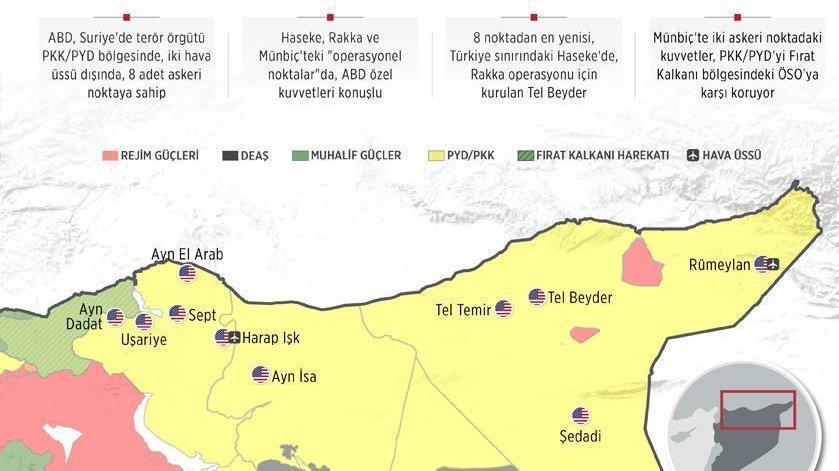
While the U.S. military presence in Syria has been ongoing since 2015 – justified as a means of countering Daesh (ISIS) — U.S. troops have since turned into an occupying force with their failure to pull out following Daesh’s defeat in northeastern Syria. Currently, the U.S. occupies nearly a third of Syrian territory — around 30 percent — including much of the area east of the Euphrates River, encompassing large swaths of the Deir Ezzor, Al-Hasakah and Raqqa regions.

Though the U.S. currently has between 2,000 to 4,000 troops stationed in Syria, it announced the training of a 30,000-person-strong “border force” composed of U.S.-allied Kurds and Arabs in the area, which would be used to prevent northeastern Syria from coming under the control of Syria’s legitimate government. Though it backtracked somewhat after backlash from Turkey, the U.S. has continued to train “local forces” in the area. Russian military sources have asserted that former members of Daesh — who were allowed to leave cities attacked by the U.S. and their proxies, as was the case in battle for Raqqa — are to be included among the force’s ranks.

This, along with the U.S. government’s insistence on maintaining the occupation until Syrian President Bashar al-Assad is removed from power, shows that the U.S. government has no intention of permitting the reunification of Syria and will continue to occupy the region over the long term.

The illegal U.S. occupation of Syria has been widely noted in independent and corporate media, but little media attention has focused on identifying the wider implications of this occupation and the U.S.’ main objectives in keeping northeastern Syria from coming under the control of the legitimate, democratically elected Syrian government. As is often the case in U.S. occupations, both historical and present, it is an effort born out of two goals: resource acquisition for U.S. corporations and the destabilization of a government targeted for U.S.-backed regime change.

Control of fossil fuel deposits and flow

Northeastern Syria is an important region owing to its rich natural resources, particularly fossil fuels in the form of natural gas and oil. Indeed, this area contains 95 percent of all Syrian oil and gas potential — including al-Omar, the country’s largest oil field. Prior to the war, these resources produced some 387,000 barrels of oil per day and 7.8 billion cubic meters of natural gas annually, and were of great economic importance to the Syrian government. However, more significantly, nearly all the existing Syrian oil reserves – estimated at around 2.5 billion barrels – are located in the area currently occupied by the U.S. government.

In addition to Syria’s largest oil field, the U.S. and its proxies in northeast Syria also control the Conoco gas plant, the country’s largest. The plant, which can produce nearly 50 million cubic feet of gas per day, was originally built by U.S. oil and gas giant ConocoPhillips, which operated the plant until 2005, after which Bush-era sanctions made it difficult to operate in Syria. Other foreign oil companies, like Shell, also left Syria as a result of the sanctions.

With the U.S. now occupying the area, the oil and gas produced in this region are already benefiting U.S. energy corporations to which Trump and his administration have numerous ties. According to Yeni Safak, the U.S. along with the Saudis, Egypt, and Kurdish officials held meetings where decisions were made to extract, process and market the fossil fuels harvested in the region, with the Kurds being given a handsome share of the profits. As of 2015, the Kurds were said to be earning in excess of $10 million every month.

Syria’s Kurdistan exports its oil to Iraq’s Kurdistan, with which it conveniently shares a border, and it is then refined and sold to Turkey. Though no corporations are publicly involved, the deal between Syrian and Iraqi Kurds was brokered by unnamed “oil experts” and “oil investors.” The Kurds in Syria and Iraq did not even sign the agreement in person. They were subsequently “informed” of the agreement by the United States and instructed to supervise the operation.

A source in Iraq’s Kurdistan Regional Government (KRG) told NOW News that “with regard to southern Kurdistan, it was a company and not the KRG that signed the deal, and it is [the company] that directly hands over the sums in cash every month.” Given that over 80 foreign companies are involved in the KRG’s oil trade, most of them U.S.-based, we can safely assume that many of the same players have also been involved in developing the oil trade of Syria’s Kurdistan.

Major corporate interests

The Trump administration’s numerous connections to the U.S. oil industry make this alliance clear. Former Secretary of State Rex Tillerson, who was fired in March, was previously the top executive at ExxonMobil, an oil company that unilaterally brokered an oil deal with Iraqi Kurds behind the back of the Iraqi government and has expressed interest in developing Syrian oil interests in the portion of the country currently occupied by the U.S.

ExxonMobil also had a major stake in the proposed Qatari pipeline, whose rejection by Assad was a likely factor in jumpstarting the Syrian conflict. Trump himself, prior to assuming the presidency, also had sizable investments in ExxonMobil — as well as in 11 other major oil and gas companies, including Total, ConocoPhillips, BHP and Chevron.

In addition, even though Tillerson has now gone, his replacement, Mike Pompeo, is equally a friend to the U.S. oil and gas industry. Pompeo is the “#1 all time recipient” of money from Koch Industries, which has numerous interests in oil and gas exploration, drilling, pipelines, and fossil-fuel refining.

While the U.S. occupation of Syria is no doubt motivated by a desire to exploit the region’s oil and gas resources for itself, the U.S.’ refusal to leave the area is also born out of a concern that, were the U.S. to leave, its chief rival, Russia, would claim the oil and gas riches of Syria’s northeast. Indeed, according to an energy cooperation framework signed in January, Russia will have exclusive rights to produce oil and gas in areas of Syria controlled by the Syrian government.

Since 2014, the U.S. has been aggressively trying to limit Russia’s fossil-fuel sector, particularly its exports to Europe, and replace themwith U.S.-produced fossil fuels. As former Speaker of the House John Boehner wrote in 2014, “The ability to turn the tables and put the Russian leader in check lies right beneath our feet, in the form of vast supplies of natural energy.” Allowing the Russian fossil fuel sector to strengthen, whether in Syria or elsewhere, would harm U.S. strategic objectives, U.S. corporate bottom lines and the U.S.’ vision of maintaining a unipolar world at all costs.

Location, location: pipeline maps and a zero-sum game with Russia

In addition to its fossil fuel resources, Syria’s strategic location makes it crucial to the regional flow of hydrocarbons. Having the northeastern section of Syria under the control of the U.S. and its proxies could have a profound effect on future and existing pipelines. As The New York Times noted in 2013, “Syria’s prime location and muscle make it the strategic center of the Middle East.”

For that very reason, much of the U.S.’ Middle East policy has been aimed at seizing control of territory and pushing for the partition of countries to secure safe transit routes for oil and gas. In Syria such plans to partition the country for this purpose date back to as early as the 1940s, when European oil interests in the country’s northeast began to grow. Since then, several countries have tried to occupy parts of northern Syria to secure control of the region for these strategic purposes, including Turkey and Iraq in addition to Western powers.

A crucial pipeline already exists in northeastern Syria that connects Syria’s oil fields to the Ceyhan-Kirkuk pipeline. Though that pipeline sustained heavy damage in 2014, there are plans to rebuild it or build a new pipeline alongside it. Thus, northeastern Syria also boasts oil export infrastructure that could help Syrian oil travel easily to Turkey and thus to the European market.

In addition, the conflict in Syria – now in its seventh year – was, in part, initiated as a result of clashes over two pipeline proposals that needed to secure passage through Syria. Syria, not long before the foreign-funded proxy war besieged the country, had turned down a U.S.-backed proposal that would take to Europe natural gas from Qatar in favor of a Russia-backed proposal that would take natural gas originating in Iran.

Though those pipeline proposals are no longer as powerful in shaping motives as they once were – largely due to Qatar’s rift with other Gulf monarchies and improved relations with Iran – the northeastern part of Syria remains key to U.S. objectives. According to the German publication Deutsche Wirtschafts Nachrichten, the U.S. has developed plans to build a new pipeline from the Persian Gulf to Northern Iraq and into Turkey through northeastern Syria, with the ultimate goal of supplying oil to Europe. Russia, for its part, opposes this plan, as it seeks to maintain its own lucrative exports of fossil fuels to Europe.

Water and land

Beyond fossil fuels and pipelines, northeast Syria boasts several other key advantages in terms of resources. Chief among those is water – a resource of prime importance in the Middle East. The U.S.-controlled portion of Syria is home to the country’s three largest freshwater reservoirs, which are fed by the Euphrates river.

One of those reservoirs now controlled by the U.S. and its proxies, Lake Assad, is the country’s largest freshwater reservoir and supplies government-held Aleppo with most of its drinking water. It also provides the city with much of its electrical power, which is generated by Tabqa Dam, also located in the occupied territory. Another key hydroelectric power plant is located at Tishrin Dam and is also controlled by U.S.-backed proxy forces.

In addition to its abundant water resources, northeastern Syria is also home to nearly 60 percent of Syria’s cropland, a key resource in terms of Syria’s sustainability and food independence. Prior to the conflict, Syria invested heavily in bringing irrigation infrastructure into the area in order to allow agriculture there to continue despite a massive regional drought. Much of that irrigation infrastructure is fed by the occupied Tabqa Dam, which controls the irrigation water for 640,000 hectares (2,500 square miles) of farmland.

Game plan for occupation, partition
Unlike the northeast’s fossil fuel resources, the U.S. is not hoping to gain financially from the region’s water and agricultural resources. Instead, the interest there is strategic and serves two main purposes.

First, control over those resources – particularly water and the flow of the Euphrates – gives the U.S. a key advantage it could use to destabilize Syria. For example, the U.S. could easily cut off water and electricity to government-held parts of Syria by shutting down or diverting power and water from dams in order to place pressure on the Syrian government and Syrian civilians.

Though such actions target civilians and constitute a war crime, the U.S. has used such tactics in Syria before, such as in the battle for Raqqa when it cut off water supplies to the city as its proxies took control of the city from Daesh (ISIS). Other countries, like Turkey, have also cut off the flow of the Euphrates on two occasions over the course of the Syrian conflict in order to gain a strategic advantage.

By controlling much of the country’s water and agricultural land – not to mention its fossil fuel resources — the U.S. occupation will not only accomplish its goal of destabilizing Syria’s government by depriving it of revenue; it also invites a broader conflict from Syria and its allies, who are eager to prevent another long-term U.S. occupation in the Middle East and to reclaim the territory for Syria.

Another way the U.S. has the ability to destabilize Syria through its occupation of the northeast is its plan to have the Saudis rebuild much of the area. Though the U.S. initially allied itself with the Kurds in northeastern Syria, opposition from Turkey has led Washington to focus more on working with Arabs in the area, particularly those allied with or formerly part of Saudi-allied Wahhabi groups, in order to create a Saudi-controlled enclave that could be used to destabilize government-controlled areas of Syria for years to come. The area is set to become much like the Idlib province, which is also essentially an enclave for Wahhabi terrorists.

The U.S. plan to create a Wahhabi enclave in northeast Syria was directly referenced in a Defense Intelligence Agency (DIA) report from 2012. That report stated:

    “THE WEST, GULF COUNTRIES, AND TURKEY [WHO] SUPPORT THE [SYRIAN] OPPOSITION… THERE IS THE POSSIBILITY OF ESTABLISHING A DECLARED OR UNDECLARED SALAFIST PRINCIPALITY IN EASTERN SYRIA (HASAKA AND DER ZOR), AND THIS IS EXACTLY WHAT THE SUPPORTING POWERS TO THE OPPOSITION WANT, IN ORDER TO ISOLATE THE SYRIAN REGIME…” [capitalization original]

Despite Daesh’s defeat, their presence in Northeastern Syria, as the DIA reveals, was cultivated to provide a pretext for the foreign control of the region.

Partition chess: thinking two moves ahead

Whether the Saudis or the Kurds ultimately end up dominating the portion of Syria currently occupied by the United States is besides the point. The main U.S. purpose in occupying the northeast portion of Syria is its long-standing goal of partitioning Syria, thereby permanently separating the country’s northeast from the rest of the country.

Throughout the Syrian conflict, the U.S. government has repeatedly tried to sell partition to the public, arguing that partition is the “only” solution to Syria’s ongoing “sectarian” conflict. However, this sectarianism was cynically engineered and stoked by foreign powers precisely to bring about the current conflict in Syria and ultimately justify partition.

WikiLeaks revealed that the CIA was involved in instigating anti-Assad and “sectarian” demonstrations as early as March 2011. Declassified CIA documents show that the plan to push partition by directly engineering sectarianism in order to weaken the Syrian state dates back to at least the 1980s. The partition idea was also repeatedly touted by the Obama administration, which stated on several occasions that it “may be too late” to keep Syria whole.

Though the Obama administration has come and gone, the Trump administration is also set to push for partition, thanks to the recent appointment of John Bolton to the position of National Security Adviser. As MintPress recently reported, Bolton has long advocated for combining northeastern Syria with northwestern Iraq in order to create a new country, which Bolton called “Sunnistan,” that would dominate the two countries’ fossil fuel resources and would count on the key water and agricultural resources of the region to sustain the population. Bolton called for the Gulf Arab states, like Saudi Arabia, to finance the creation of that state – hence the Trump administration’s recent attempts to negotiate a “deal” with the Saudis by which they take over control of the U.S.-occupied portion in Syria if they agree to pay $4 billion for reconstruction.

Aiming at Iran

While gaining control of key resources for partitioning Syria and destabilizing the government in Damascus, the U.S.’ main goal in occupying the oil and water rich northeastern Syria is aimed not at Syria but at Iran.

As U.S.-based intelligence firm Stratfor noted in 2002, taking control of Syria’s northeast would greatly complicate the land route between Syria and Iran as well as the land route between Iran and Lebanon. In January, Tillerson made this objective clear. Speaking at Stanford University, Tillerson noted that “diminishing” Iran’s influence in Syria was a key goal for the U.S. and a major reason for its occupation of the northeast.

By cutting off the route between Tehran and Damascus, the U.S. would greatly destabilize and weaken the region’s “resistance axis” and the U.S. — along with its regional allies – would be able to greatly increase its regional influence and control. Given the alliance between Syria and Iran, as well as their mutual defense accord, the occupation is necessary in order to weaken both nations and a key precursor toTrump administration plans to isolate and wage war against Iran.

With internal reports warning of the U.S.’ waning position as the “world’s only superpower,” the U.S. has no intention of leaving Syria, as it is becoming increasingly desperate to maintain its influence in the region and to maintain as well the influence of the corporations that benefit the most from U.S. empire.

Acknowledgment: Investigative journalist Rick Sterling, who specializes in the Syria war, provided MintPress with some images and pertinent information that was used in this story.


*

Whitney Webb is a staff writer for MintPress News and a contributor to Ben Swann’s Truth in Media. Her work has appeared on Global Research, the Ron Paul Institute and 21st Century Wire, among others. She has also made radio and TV appearances on RT and Sputnik. She currently lives with her family in southern Chile.

The original source of this article is MintPress News
Copyright © Whitney Webb, MintPress News, 2018

Fa(c/k)ebook to cease data collection ?!

A fake reason is often given to justify that like any crisis, scandal etc. Also the real betrayal to fbook users is not really the data sales, advertizers and marketers, its the intel services who use them all, its the third party rogue agts who get in and out your fbook account anytime, and fb knows it all meaning fb is part of a big organized cabal. That is a very important thing and people should know this one. Cambridge Analytica was disinfo part. That would be all.


Facebook says it will cease cooperation with all third-party data collectors
RT : 29 Mar, 2018

Facebook has said it will no longer offer an advertising option that exploits personal data provided by third-party aggregators. The company, still bleeding from the Cambridge Analytica scandal, said it wants to improve privacy.

Among the companies that will be affected by the new measure are: Acxiom, which provides data from the US, the UK, France, Germany and Australia, Epsilon, which monitors the US consumer preferences, as well as Oracle Data Cloud, which collects data in the US and the UK, Experian, TransUnion and others, Facebook Product Marketing Director Graham Mudd indicated in a statement that was circulated by industry news sites.

The companies, all major data aggregators, helped Facebook to provide advertisers with valuable information concerning consumer behavior outside the web. This included the users' shopping habits, information on their home or car ownership, family make-up and other offline data that is essential for advertisers to make a precise targeting choice.

The aggregators partnered with Facebook so when the advertisers paid to use the option, Facebook would transfer a portion of the money received to the third-party company that harvested the data.

The social media giant plans to gradually phase out the service, known as "Partner Categories," within half a year.

"We want to let advertisers know that we will be shutting down Partner Categories," it said in a statement, noting that "while this is common industry practice, we believe this step, winding down over the next six months, will improve people's privacy on Facebook."

The decision comes on the heels of a data mining scandal involving the British firm Cambridge Analytica, which is accused of harvesting the data of 50 million Facebook users without their explicit knowledge or consent. Earlier this week, a legal complaint was filed against the firm, with the Federal Election Commission (FEC) and the US Department of Justice alleging it violated the law barring foreign entities from engaging in political campaigning.

Several reports and whistleblowers linked the firm to the Donald Trump presidential bid, alleging his campaign forked out $5 million to pay for its services.

In the wake of the scandal, the social media giant's stocks plummeted and its CEO, Mark Zuckerberg offered an extensive apology, in which he described the leak of users' personal data as a "breach of trust." The attempt at damage control, however, did not move the EU, which accused Facebook and its CEO of a lackluster response and demanded guarantees that such a scenario would not be repeated.

Faced with an unprecedented public backlash, Zuckerberg has reportedly decided to testify before Congress on the issue. At the same time, he refused to appear before the British Parliament, sparking outrage in the UK, while offering to send one of his senior staffers to give evidence to MPs.


Selected Comments:

# And of course we believe you because the CIA and NSA never lie.

# The only thing Jewkerberg is sorry about is his stock value plummeting.

# I notice there's no investigation into Fuckerbergs insider trading, he sold off a lot of stock just before this story broke.

# FB is a third party data collector.

US has a long history of lying to start wars

 # 9/11 was the false flag that kick started the Greater Israel Project.

False flags are real – US has a long history of lying to start wars
Danielle Ryan
RT : 16 Apr, 2018

Use of the term ‘false flag’ is often met with raised eyebrows and accusations of conspiracism. But false flags are a very real and very present feature of geopolitics — and denying that is simply denying reality.

Last week, the United States, along with the United Kingdom and France, bombed Syrian government targets, ostensibly in retaliation for an alleged chemical attack which was carried out one week before in the city of Douma.

The story we’re told is simple: Syrian President Bashar Assad is an evil maniac who uses poison gas on his citizens for the sheer entertainment value. As neocon think tank the Atlantic Council put it last week, when Assad gasses people, he is simply “indulging an addiction” — an addiction which he seems to have only recently acquired, given the fact that before Syria’s war began, American journalists were busy praising the “educated” and “informed” Assad and marveling at the “phenomenal” levels of peace and religious diversity within Syria.

Anyway, so intense is Assad’s newfound desire for watching Syrian babies foaming at the mouth, that he is willing to snatch defeat from the jaws of victory by deciding to use these weapons despite knowing it would provoke worldwide outrage and potentially a major US military effort to oust him. So, that’s the story. Assad is a monster and the world must unite to stop him.

There are plenty of people who are less than convinced by this narrative, however. One of them is Peter Ford, the former British ambassador to Syria. Ford told BBC Radio Scotland that “in all probability” the alleged chemical attack never happened and that the video and image evidence used as proof by the US and its allies was falsified. There are others who believe that the attack could have been real, but that the perpetrators were anti-Assad rebels trying to provoke fresh military action from the US — in other words, it was very possibly a false flag event which served its purpose perfectly.

One of the best questions to ask when something like this happens, is: Who benefits? Very clearly in this case, Assad has not benefited at all, but the rebel groups fighting against him have.

Whatever the truth about this alleged chemical attack, the notion of false flag events being used to prompt military action should not be met with such skepticism. The US has a long history of using lies (or ‘fake news’ you might call it) as a pretext for war. It is important to look at recent events in Syria within that context.
Nayirah testimony

Perhaps the most famous of all examples was the heart-wrenching testimony to Congress of a 15-year-old Kuwaiti girl, identified only as Nayirah, which was used to sell the first Gulf War to the American people in October 1990. An emotional Nayirah told the Congressional Human Rights Caucus that she had witnessed Iraqi soldiers taking babies out of incubators and leaving them on the floor to die.

What Americans did not know, was that Nayirah was the daughter of the Kuwaiti ambassador to the US and she had been coached by the American PR firm Hill and Knowlton. But before the details of the stunt and false testimony became widely known, it had already been used to sell America’s war against Iraq in 1991.

Operation Northwoods

In the 1960s, American military leaders devised plans to bomb US cities and blame Cuban leader Fidel Castro in order to manufacture public and international support for a war.

The plan was codenamed Operation Northwoods and what it advocated was nothing short of horrendous. The American military suggested sinking boatloads of Cuban refugees, hijacking planes and bombing Miami. The goal was to convince Americans that Castro had unleashed a reign of terror upon them.

The top brass were even willing to cause US military casualties by blowing up an American boat in Guantanamo Bay and blaming Cuba. Why? Because, as they put it, “casualty lists in US newspapers would cause a helpful wave of national indignation” and help manufacture support for war. The plans were quashed by President John F. Kennedy, who was assassinated one year later, leading some to speculate on a link between those events.
Gulf of Tonkin

Top US officials also distorted the facts in the lead-up to the Vietnam War and the media dutifully reported the official narrative as absolute fact, helping launch perhaps the most disastrous war in America’s history.

On August 2, 1964, North Vietnamese torpedo boats attack the USS ‘Maddox’ while it was on “routine patrol” in international waters in the Gulf of Tonkin. Two days later, the US Navy reported a second “unprovoked” attack on the ‘Maddox’ and the USS ‘Turner Joy’ — a second destroyer which had been sent in after the first attack. President Lyndon B. Johnson told the American people on TV that “repeated acts of violence” against the US ships must be met with a strong response. Soon after Johnson appeared on TV, Congress passed the Gulf of Tonkin Resolution, which pre-approved any military action that he would take from that moment on.

The only problem was, there was no second attack on the US ships at all — and the allegation that the first attack had been “unprovoked” was also a lie. In reality, the USS ‘Maddox’ had been gathering intelligence and providing it to South Vietnamese boats which were attacking North Vietnam. As for the second attack, the US boats had misinterpreted radio signals and radar images and spent two hours firing at nothing. Nonetheless, the “attack” was used to convince the American people to support war.

Soviet aircraft false flags

Recently declassified documents show yet more American false flag plotting, this time against the Soviet Union. A three-page memo, written by members of the National Security Council, suggested that the US government should acquire Soviet aircraft which would be used to stage attacks and provide the pretext for war.

Such aircraft, the memo said, “could be used in a deception operation designed to confuse enemy planes in the air, to launch a surprise attack against enemy installations or in a provocation operation in which Soviet aircraft would appear to attack US or friendly installations to provide an excuse for US intervention."

The government even considered producing the soviet planes domestically in a massive covert operation. They went so far as to acquire estimates from the Air Force on the cost and length of time such an operation would take.

This is by no means an exhaustive list. Is there even any need to rehash the lies which were told in the lead-up to the Iraq war? The media here again swallowed the government’s lies, one by one — and 15 years later, the region is still suffering the consequences and very few lessons appear to have been learned.

These are not conspiracy theories. They are cold, hard evidence that the US has no qualms whatsoever about using false flag events and fake evidence to provide pretext for military action.

Continued lack of critical inquiry from the media, given the severe potential consequences of escalating the conflict in Syria, is tantamount to a crime.

- - -

Danielle Ryan is an Irish freelance journalist. Having lived and worked in the US, Germany and Russia, she is currently based in Budapest, Hungary. Her work has been featured by Salon, The Nation, Rethinking Russia, Russia Direct, teleSUR, The BRICS Post and others. Follow her on Twitter @DanielleRyanJ, check out her Facebook page, or visit her website: danielle-ryan.com

Thursday, April 12, 2018

An Ayah a day keeps shaytan away...

An Ayah a day keeps shaytan away
Warda Zahid

The Holy Quran is a complete code of conduct for the Muslims. Reciting even a small portion of it is conducive to repelling the Satan. The code of conduct is expressive in every verse of the Holy Quran and with due comprehension, these verses can lead to a life free from the temptations of the Satan. The proximity with the message of the Holy Quran is a remedy from all the temptations of the Satan. Holy Quran contains solutions to all our worldly and spiritual problems. It is the miracle that Allah presented to Holy Prophet (PBUH) and told him to vociferously preach its word to the
mankind.

Surah Al Furqan establishes Holy Quran as the Criterion for success for the Muslims. Therefore, Quran is full of guidance on the road to success.

Recitation and comprehension of a single ayat every day is a small price to pay to achieve success. A person can only be successful in front of Allah if he/she is free from the influence of the Satan. In a nutshell, Quran teaches us how to repel the futile temptations of the Satan.

In order to fulfill our daily obligations, we tend to keep away from the Holy Quran. This drives a wedge between us and Allah and allows the Satan to tempt us into incurring sinful activities. These activities eventually lead us astray. Recitation of an ayat daily will remind us that we have to
fulfill the covenant with Allah Almighty. In accordance with that covenant, we will undertake pious actions in our lives. Furthermore, we will take one step a day on the road towards piety (Taqwa). Piety is the state in which a Muslim only performs those actions which are in conformity to the laws put forth by Allah.

Reading an ayat a day is a source of constant reminder that Allah is the Lord and the Cherisher of the universe and we should direct all our prayer to Him alone. It will also remind us of the merciful and forgiving nature of Allah and that we shall implore Him in the hour of need.

Holy Quran also contains a plethora of supplications that one can recite on daily basis. In Surah Al Baqarah, verse 201, Quran says:  Our Lord! Give us in this world that which is good and in the Hereafter that which is good, and save us from the torment of the Fire! (Al-Baqarah, 201)

Recitation of this surah proclaims the Lordship of Allah and rejection of the Satan. It also entails Allah to be the sole provider and cherisher of the universe. The reciter implores Allah to provide only what is good in this world and in the Hereafter. The reciter also asks for protection against the
blazing Hellfire. Ayats like this inculcate the fear of Allah in our hearts and save us from the evil and shrewd intentions of the Satan.

An ayah a day fosters and rekindles the concept of faith in a Muslim’s heart. He conforms to the ideology and teachings of Islam so that the odds of going astray are minimized to a great extent. Quran says in Surah Al-Baqarah:

    "And behold, We said to the angels: "Bow down to Adam" and they bowed down. Not so Iblis: he refused and was haughty: He was of those who reject Faith."

This ayat is a testament to the fact that the presence of strong faith eradicates all the evils of Satan from the heart of a Muslim. One can only strengthen faith using the text of the Holy Quran as it is the ultimate word of Allah.

I Cannot Obey Allah in Public and Disobey Him in Private!

Narrated Abdullah ibn Zayd ibn Aslam, from his father, from his grandfather, {Allah be pleased with them }~ who said...

When I was accompanying `Umar ibn al-Khattab (Radi Allahu ‘Anhu) on his patrol of Madinah at night, he felt tired, so he leaned against a wall. It was

the middle of the night...and (we heard) a woman say to her daughter...

“O my daughter, get up and mix that milk with some water.” {!}
The girl answered...
'O Mother, did you not hear the decree of  Amir al-Mu’minin today ? ”
The mother answered...
“What was that ?”
The girl said...
'He ordered someone to announce in a loud voice that milk should not be mixed with water.'
The mother then said...'Get up and mix the milk with water ! you are in a place where `Umar (Radi Allahu`Anhu ) cannot see you.'
The girl answered her mother...
"I cannot obey Allah in Public and Disobey Him in Private !”

'Umar (Radi Allahu ‘Anhu) heard this, and told me...

“O Aslam, go to that place and see who that girl is, and to whom she was speaking, and whether she has a husband.”

So I went to that place, and I saw that she was unmarried, the other woman was her mother, and neither of them had a husband.

I came to `Umar (Radi Allahu ‘Anhu) and told him what I had found out.

He called his sons together, and said to them...

'Do any of you need a wife, so I can arrange the marriage for you ' ?'If I had the desire to get married, I would have been the first one to marry this young woman !'

`Abdullah said: “I have a wife.
`Abd al-Rahman said: “I have a wife'.
`Asim said:"I do not have a wife, so let me marry her.”

So `Umar (Radi Allahu ‘Anhu) arranged for her to be married to `Asim.

A Lil Note ... She gave him a daughter, who grew up to be the Mother of ...Umar ibn `Abd al-`Aziz (Rahimahullah) !

Ganging up on Russia...

The reasons should be obvious; anyway they are explained below for the interested readers...

Why the UK, the EU and the US Gang-Up on Russia
By Prof. James Petras
Global Research, March 21, 2018

Introduction

For the greater part of a decade the US, the UK and the EU have been carrying out a campaign to undermine and overthrow the Russian government and in particular to oust President Putin. Fundamental issues are at stake including the real possibility of a nuclear war.

The most recent western propaganda campaign and one of the most virulent is the charge launched by the UK regime of Prime Minister Theresa May. The Brits have claimed that Russian secret agents conspired to poison a former Russian double-agent and his daughter in England , threatening the
sovereignty and safety of the British people. No evidence has ever been presented. Instead the UK expelled Russian diplomats and demands harsher sanctions, to increase tensions. The UK and its US and EU patrons are moving toward a break in relations and a military build-up.

A number of fundamental questions arise regarding the origins and growing intensity of this anti-Russian animus.

Why do the Western regimes now feel Russia is a greater threat then in the past? Do they believe Russia is more vulnerable to Western threats or attacks? Why do the Western military leaders seek to undermine Russia’s defenses? Do the US economic elites believe it is possible to provoke an

economic crisis and the demise of President Putin’s government? What is the strategic goal of Western policymakers? Why has the UK regime taken the lead in the anti-Russian crusade via the fake toxin accusations at this time?

This paper is directed at providing key elements to address these questions.

The Historical Context for Western Aggression

Several fundamental historical factors dating back to the 1990’s account for the current surge in Western hostility to Russia.

First and foremost, during the 1990’s the US degraded Russia, reducing it to a vassal state, and imposing itself as a unipolar state.

Secondly, Western elites pillaged the Russian economy, seizing and laundering hundreds of billions of dollars. Wall Street and City of London banks and overseas tax havens were the main beneficiaries

Thirdly, the US seized and took control of the Russian electoral process, and secured the fraudulent “election” of Yeltsin.

Fourthly, the West degraded Russia’s military and scientific institutions and advanced their armed forces to Russia’s borders.

Fifthly, the West insured that Russia was unable to support its allies and independent governments throughout Europe, Asia, Africa and Latin America.

Russia was unable to aid its allies in the Ukraine, Cuba, North Korea, Libya etc.

With the collapse of the Yeltsin regime and the election of President Putin, Russia regained its sovereignty, its economy recovered, its armed forces and scientific institutes were rebuilt and strengthened. Poverty was sharply reduced and Western backed gangster capitalists were constrained, jailed or fled mostly to the UK and the US.

Russia’s historic recovery under President Putin and its gradual international influence shattered US pretense to rule over unipolar world. Russia’s recovery and control of its economic resources lessened US dominance, especially of its oil and gas fields.

As Russia consolidated its sovereignty and advanced economically, socially, politically and militarily, the West increased its hostility in an effort to roll-back Russia to the Dark Ages of the 1990’s.

The US launched numerous coups and military intervention and fraudulent elections to surround and isolate Russia . The Ukraine, Iraq, Syria, Libya, Yemen and Russian allies in Central Asia were targeted. NATO military bases proliferated.

Russia’s economy was targeted : sanctions were directed at its imports and exports. President Putin was subject to a virulent Western media propaganda campaign. US NGO’s funded opposition parties and politicians.

The US-EU rollback campaign failed.

The encirclement campaign failed.

The Ukraine fragmented – Russia allies took control of the East; Crimean voted for unification with Russia. Syria joined with Russia to defeat armed US vassals. Russia turned to China’s multi-lateral trade, transport and financial networks.

As the entire US unipolar fantasy dissolved it provoked deep resentment, animosity and a systematic counter-attack. The US’s costly and failed war on terror became a dress rehearsal for the economic and ideological war against the Kremlin ..Russia’s historical recovery and defeat of Western rollback
intensified the ideological and economic war.

The UK poison plot was concocted to heighten economic tensions and prepare the western public for heightened military confrontations.

Russia is not a threat to the West: it is recovering its sovereignty in order to further a multi-polar world. President Putin is not an “aggressor” but he refuses to allow Russia to return to vassalage.

President Putin is immensely popular in Russia and hated by the US precisely because he is the opposition of Yeltsin – he has created a flourishing economy; he resists sanctions and defends Russia’s borders and allies.

Conclusion

In a summary response to the opening questions.

1) The Western regimes recognize that Russia is a threat to their global dominance; they know that Russia is no threat to invade the EU, North America or their vassals.

2) Western regimes believe they can topple Russia via economic warfare including sanctions. In fact Russia has become more self-reliant and has diversified its trading partners, especially China, and even includes Saudi Arabia and other Western allies.

The Western propaganda campaign has failed to turn Russian voters against Putin. In the March 19, 2018 Presidential election voter participation increased to 67% ..Vladimir Putin secured a record 77% majority. President Putin is politically stronger than ever.

Russia’s display of advanced nuclear and other advanced weaponry has had a major deterrent effect especially among US military leaders, making it clear that Russia is not vulnerable to attack.

The UK has attempted to unify and gain importance with the EU and the US via the launch of its anti-Russia toxic conspiracy. Prime Minister May has failed. Brexit will force the UK to break with the EU.

President Trump will not replace the EU as a substitute trading partner. While the EU and Washington may back the UK crusade against Russia they will pursue their own trade agenda; which do not include the UK.

In a word, the UK, the EU and the US are ganging-up on Russia, for diverse historic and contemporary reasons. The UK exploitation of the anti-Russian conspiracy is a temporary ploy to join the gang but will not change its inevitable global decline and the break-up of the UK.

Russia will remain a global power. It will continue under the leadership of President Putin. The Western powers will divide and bugger their neighbors – and decide it is their better judgment to accept and work within a multi-polar world.

Illegitimate Debts at the Core of Capitalist System

Capitalism is baring its ugly face as the time passes...


The Struggle Against Illegitimate Public and Private Debt Which Are at the Core of the Capitalist System
By Eric Toussaint
CADTM 6 April 2018
 The seventh CADTM South Asia regional workshop started in Colombo (Sri Lanka) on April 6, 2018, with participants coming from Sri Lanka, India, Pakistan, Bangladesh, Nepal, Japan, Belgium and France. Below is the general introduction by Éric Toussaint, spokesperson for the CADTM international network.

What we are fighting is a capitalist system that destroys nature.

We have to fight a capitalist system which, within the two centuries since the so-called Industrial Revolution, has accumulated enough greenhouse gases to trigger climate change.

It sees nature merely as resources to be extracted, exploited and traded for maximal profit.

A capitalist system that confines the inhabitants of many countries to producing raw material to be exported at the lowest possible price.

A system that drives people to produce food they will not eat and to eat food they have not produced.

A system that sets up and maintains nuclear plants which must urgently be shut down.
A capitalist system which perpetuates or even strengthens the oppression and exploitation of women. A capitalist system which perpetuates the cast system and racist policies.

A capitalist system which increases inequalities all over the planet.

A capitalist system which goes hand in hand with the debt system.

Illegitimate private debt

The debt system existed long before the capitalist system but it has thrived under capitalism.

Private debt has been used for millennia as a way of depriving peasants of their land, craftsmen of their tools. Slavery for debt was common during Classical Antiquity and is still existing in South Asia and other part of the world.

The system of illegitimate private debt usually involves imposing conditions of loans and repayment that make the latter impossible. This results in seizure (of housing, land, working tools) and/or in the need to consign long years or indeed decades to repaying debts.

History is littered with uprisings against the burden of illegitimate private debt, whether in Ancient Greece, in Northern Europe during the Middle-Ages or in Asia.

Those struggles against illegitimate debts are once more in spate:

    Peasants’ struggles for debt cancellation in India
    Women’s struggles against microcredit in Morocco, Bangladesh and Sri Lanka
    Students’ struggles against student debt in the US, Chile, Canada, Japan and in the UK,
    Household struggles against abusive mortgages and house seizures in Spain, the US, Greece and in Ireland.

Illegitimate public debt

The system of illegitimate debt is also used by the capitalist system to subject public policies to the demands of Capital. While public debt could be used to finance an ambitious programme of ecological transition and social justice… it is actually used to enforce anti-social, extractivist and productivist policies, policies that increase competition between peoples.

Public debt is not bad in itself. Governments can contract loans to finance the ecological transition:

    to finance the complete shutdown of nuclear plants;
    to replace fossil energies with renewable energies which respect the environment;
    to finance land reform;
    to drastically reduce road and air transport and replace them with collective transport by rail.

Public borrowing can thus be legitimate if it is used to finance legitimate projects and if those who contribute act in a legitimate way.

The CADTM believes that big companies and the richer households should contribute to non profit-making government loans, i.e. with zero interest rate and without compensation against inflation.

At the same time, a part of the households of the popular classes which are able to spare money could make voluntary contributions to finance the state with a positive interest return rate (for instance, 3% real interest rate in favour of the savings of the popular families. If the rate of inflation is 4% a year, the nominal interest rate guaranteed by the government should be 7% in order to make sure that the real interest rate earned by these popular classes is 3%).

This mechanism would be highly legitimate as it would finance projects which are useful for society while reducing the wealth of the richest and simultaneously increasing the poorer classes’ revenues.

The opposite happens: governments and local authorities mostly borrow to finance illegitimate policies such as:

    armaments expenses;
    white elephants;
    nuclear plants;
    public-private partnerships;
    repayment of former illegitimate debts;
    bailing out banks.

Public debt is thus used to finance illegitimate expenses. The way repayment of the debt is financed is illegitimate too: big companies and the richer households pay little or no taxes. Those on limited incomes have to tighten their belts to repay the debt. In the name of debt repayment, the state implements budget cuts in the social services, thus impacting the poor. Private banks grant loans to governments at profitable rates for themselves while they borrow at a very low rate from the central bank as is the case in the Eurozone or in Japan.

We can draw a straightforward conclusion: it is time to end the system of illegitimate public and private debt.

The CADTM is radically committed to fighting at local and international level with social movements and citizens toward the repudiation of illegitimate debts, whether public or private.

If public authorities with popular support wish to get involved, the CADTM is available and ready to help, for instance in the organization of citizens’ audits, as happened in Ecuador in 2007-2008, Paraguay in 2008 and Greece in 2015.


*
Eric Toussaint is a historian and political scientist who completed his Ph.D. at the universities of Paris VIII and Liège, is the spokesperson of the CADTM International, and sits on the Scientific Council of ATTAC France.
He is the author of Bankocracy (2015); The Life and Crimes of an Exemplary Man (2014); Glance in the Rear View Mirror. Neoliberal Ideology From its Origins to the Present, Haymarket books, Chicago, 2012 (see here), etc.